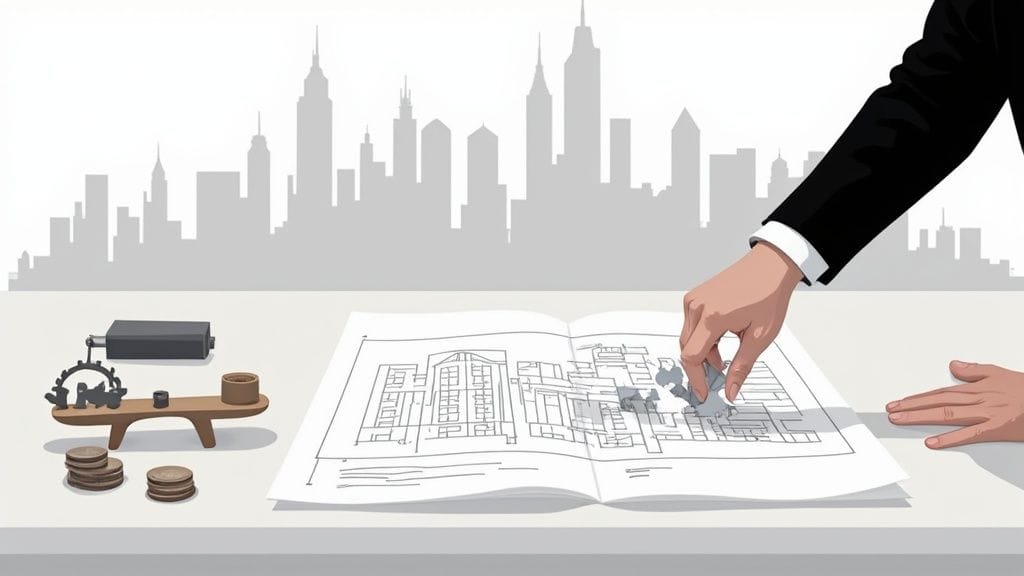
Value engineering is often misunderstood. It’s a powerful, systematic way to boost a project's 'value' by digging into its functions, not just trying to shave off initial costs. The big idea is that real value is the perfect balance between function and cost. This ensures every dirham you spend has a clear, essential purpose—without ever cutting corners on quality.
Understanding Value Engineering Beyond Cost Cutting
Too many people in the construction world hear "value engineering" and immediately think "cost cutting." They see it as a last-ditch effort to slash expenses when a project is running over budget. This view isn't just wrong; it completely misses the huge strategic advantage VE brings to the table, especially in a competitive market like Dubai.
True value engineering isn’t about making things cheaper; it's about making them smarter. It’s a creative, organized process that puts every single component and process under the microscope. The goal? To make sure each part delivers its function at the lowest possible life-cycle cost. That means we’re looking at the big picture—not just the price tag today, but also the long-term costs of operations, maintenance, and durability.
The Core Principle: Function Over Features
At its heart, value engineering flips a common question on its head. Instead of asking, "What is this component?" it asks, "What does this component do?" This simple shift from identity to function opens up a world of new possibilities.
Take a wall, for instance. Its purpose isn't just to be a wall. Its functions might include providing structural support, blocking sound, or offering thermal insulation.
Once we’re focused on the function, the project team can brainstorm other, often better, ways to get the same result. This could mean:
- Using a different material that performs the same function more effectively or at a lower price point.
- Combining several functions into one smarter, more efficient component.
- Getting rid of elements that drive up costs but add very little to the project's real purpose.
To really grasp the difference, it helps to see these two approaches side-by-side.
Value Engineering vs. Traditional Cost Cutting
| Aspect | Value Engineering (VE) | Traditional Cost Cutting |
|---|---|---|
| Focus | Maximizing value by improving the function-to-cost ratio. | Reducing initial expenses, often without considering long-term impact. |
| Timing | Proactive; integrated early in the design phase. | Reactive; typically applied late in the project when budgets are tight. |
| Scope | Holistic; considers the entire project life cycle. | Narrow; focuses only on upfront construction or material costs. |
| Outcome | Often improves quality, performance, and sustainability. | Can lead to lower quality, higher maintenance costs, and reduced functionality. |
| Mindset | "How can we achieve this function more intelligently?" | "How can we make this cheaper?" |
As you can see, VE is a strategic discipline focused on long-term project health, while traditional cost cutting is often a short-term fix that can create bigger problems down the line.
Value Engineering in the Dubai Context
In the fast-moving development world of Dubai and the wider GCC, getting projects done on time and on budget is everything. Value engineering has become an essential tool for making that happen. It helps teams pivot towards projects with quicker returns and tighter expense controls by systematically weighing all the options right from the start.
By applying this disciplined analysis, firms can significantly cut project costs and boost the return on investment. You can find more details on how this strategy is applied in the Middle East to learn more about its regional impact.
Value engineering is the art of achieving maximum function for every dirham spent. It transforms the conversation from 'How can we make this cheaper?' to 'How can we achieve this function more intelligently?'
As a firm deeply rooted in Dubai's construction landscape since 1998, Freeline Engineering Consultants understands this distinction perfectly. Our approach isn't about suggesting cheaper, lower-quality materials for your villa, residential building, or warehouse project. It's a collaborative journey where we work with you to understand your core goals—whether you're building a luxury villa community, a G+4 residential block, or an industrial facility.
We then apply rigorous functional analysis to ensure the final design is lean, efficient, and perfectly aligned with your vision. The result is optimal value that never sacrifices the quality and integrity your investment deserves. Ready to build smarter? Let's discuss how our value engineering expertise can elevate your next project.
The Structured VE Job Plan: A Proven Roadmap to Value
Value engineering isn't just a brainstorming session where people throw ideas at a wall to see what sticks. It’s a disciplined, structured journey with a clear and proven roadmap. This systematic process, often called the VE Job Plan, is what ensures every analysis is thorough, creative, and razor-focused on delivering maximum value. It takes the abstract goal of "improving value" and turns it into a concrete, multi-phase methodology that guides project teams from initial questions to final, actionable recommendations.
Understanding this job plan is the key to grasping the core of value engineering. It’s a collaborative, workshop-based approach that systematically generates and refines innovative solutions. For clients here in Dubai, this structured process provides total transparency and ensures every decision is driven by data and perfectly aligned with their strategic goals.
This isn’t a new concept; the process has evolved over decades to become a global standard. This infographic shows a few key milestones in its development.
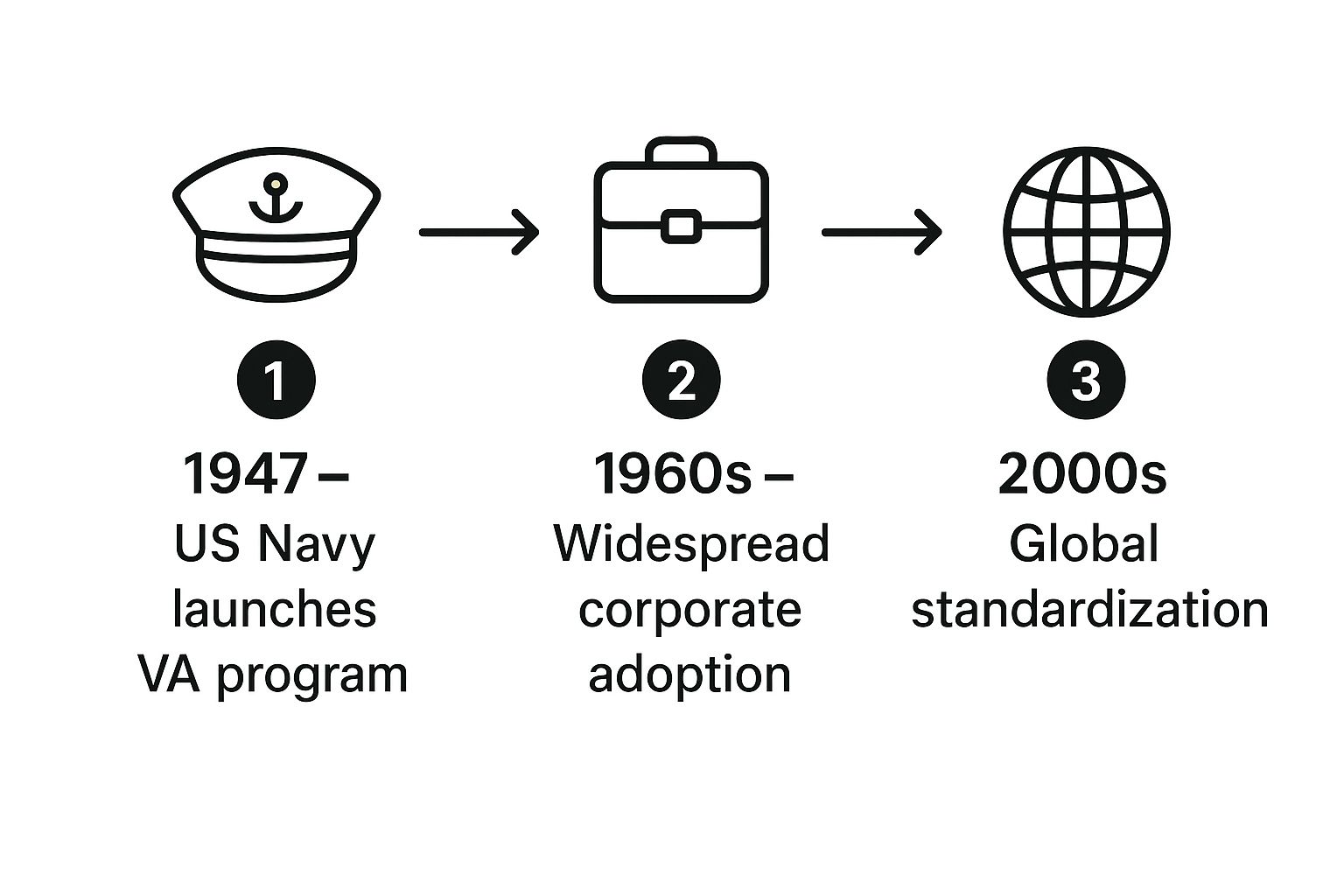
As you can see, value engineering grew from a specific military application into a widely adopted corporate strategy. Eventually, it became a standardized practice across global industries, including Dubai's demanding construction sector.
The Six Phases of the VE Job Plan
The standard VE job plan is typically broken down into six distinct phases. Each stage has a specific purpose and set of activities, ensuring a comprehensive and logical progression from start to finish.
Information Phase: This is the foundation. The team gathers all relevant project data—designs, costs, specifications, and the client's ultimate objectives. The goal is simple: understand the project inside and out before making a single suggestion.
Function Analysis Phase: Here’s where the magic really happens. Instead of just looking at project components, the team defines the functions they perform using a simple verb-noun combination (e.g., "support roof," "provide light").
Creative Phase: Also known as the speculation phase, this is where the team brainstorms every possible way to perform the identified functions. No idea is too unconventional at this stage. The aim is to generate a high volume of diverse solutions.
Evaluation Phase: Now, the team systematically analyzes the ideas from the creative phase. They're judged against criteria like cost, feasibility, and how well they meet the project's core functions, which helps narrow the list down to the most promising options.
Development Phase: The top ideas are fleshed out. The team conducts detailed technical and cost analyses to develop these raw concepts into viable, well-documented proposals.
Presentation Phase: Finally, the team presents its formal recommendations to the client and key stakeholders. This report outlines the proposed changes, potential savings, and a clear implementation plan, making a strong case for adoption.
A Deeper Look at Function Analysis in Dubai
The Function Analysis phase is what truly separates value engineering from simple cost-cutting. A powerful tool used here is the Function Analysis System Technique (FAST) diagram. This visual map helps the team see how functions relate to one another, identifying the core purpose of a system versus its supporting functions.
Let's apply this to a common Dubai project: a G+4 commercial building in a district like Jumeirah. The team might be analyzing the building's facade.
The question shifts from "What material should the facade be?" to "What must the facade do?"
By framing it this way, the functions could be:
- Primary Function: "Protect interior."
- Secondary Functions: "Provide aesthetics," "Control sunlight," "Reduce noise," and "Support signage."
By breaking it down like this, the team can explore alternatives that fulfill these functions more efficiently. Perhaps a different, locally sourced cladding material offers the same protection and aesthetic appeal but at a 15% lower cost and with better thermal performance. That single change reduces not only upfront costs but also long-term cooling expenses. This is a perfect example of improving the function-to-cost ratio without compromising quality. Our guide to value engineering in construction explores more real-world applications and techniques like this.
At Freeline Engineering Consultants, we guide our clients through this rigorous job plan on every project. Our deep experience in the Dubai market allows us to quickly identify high-impact areas for value improvement, ensuring your project—whether it's a residential block or an industrial warehouse—achieves its essential functions at the best possible life-cycle cost.
Why Value Engineering Is Essential for Dubai's Construction
Dubai's construction scene is a remarkable mix of jaw-dropping ambition and tough, on-the-ground practicalities. It’s a high-stakes environment where developers and contractors are always juggling rapid development cycles, unpredictable material costs, and an unrelenting push for perfection. In a market this dynamic, value engineering isn't just a "nice-to-have"—it's a critical tool for survival and success.
Think of it as a strategic playbook that helps projects, especially in the common low- to mid-rise sector (such as villas, warehouses, and G+4 buildings), truly thrive. Instead of just slashing costs blindly, value engineering provides a smart, structured way to deliver projects on schedule and within budget, all while boosting the building's long-term performance and profitability.
The sheer scale of development here makes this approach vital. Back in 2020, the UAE claimed the largest share of awarded construction projects in the MENA region, valued at roughly USD 13.4 billion. With the government heavily invested in housing, education, and healthcare, value engineering is essential to make sure every dirham of that massive spend is used as efficiently as possible.
Navigating Market Volatility and Ambitious Timelines
The global supply chain for building materials is notoriously unpredictable. Prices for basics like steel and concrete can jump overnight, and for a Dubai project on a tight deadline, that can spell disaster for the budget. Value engineering acts as a proactive defense against this kind of chaos.
By getting in early and analyzing a building’s core functions, teams can pinpoint alternative, locally sourced materials or clever construction methods that do the same job without being at the mercy of volatile international markets. This focus on intelligent substitution is a cornerstone of effective building construction project management.
This doesn't just keep costs in check; it can also seriously speed up the project. Cutting down on imported materials means fewer logistical headaches and delays, helping teams hit the ambitious deadlines that are part of Dubai's DNA.
Aligning with Dubai's Vision for Sustainability
Dubai isn’t just building bigger; it’s building smarter and greener. Big-picture plans like the Dubai 2040 Urban Master Plan are all about sustainability, using resources wisely, and creating healthier places to live. Value engineering fits perfectly with these forward-thinking ambitions.
A VE workshop is designed to question everything and eliminate waste.
- Resource Optimization: Does this structural beam use more concrete than it absolutely needs to?
- Lifecycle Costs: Can we choose an MEP system that costs a bit more upfront but saves a fortune on energy bills down the line?
- Material Innovation: Is there a recycled or sustainable material available that performs better and has a smaller carbon footprint?
By focusing on the entire lifecycle of a building, value engineering shifts the perspective from short-term construction costs to long-term asset value and operational efficiency, directly supporting the city's sustainability objectives.
Freeline Engineering Consultants: The Right Partner for Dubai
In a market as complex as Dubai's, you need a consultant who knows the local landscape inside and out. At Freeline Engineering Consultants, we've been tackling the unique challenges of the UAE's construction sector since 1998. We don’t offer generic, one-size-fits-all solutions. We apply the rigorous principles of value engineering specifically to the context of your villa, warehouse, or mid-rise residential project.
We get that "value" means something different to every client. It could be maximizing rental income for a residential building, slashing operational costs for a warehouse, or achieving a stunning look for a luxury villa. Our entire process is built around what success looks like for you.
Our workshops are collaborative, bringing your designers, engineers, and stakeholders to the table to challenge old assumptions and uncover new opportunities. We don't just trim line items from a budget; we find smart ways to enhance the fundamental value of your investment.
Ready to build with more efficiency and confidence? Contact Freeline Engineering Consultants today for a consultation and discover how our tailored value engineering services can ensure your next project is a resounding success.
Key Benefits of Value Engineering: More Than Just Savings
Of course, theory is one thing, but the real power of Value Engineering shows up in the concrete, measurable benefits it brings to a project. When you move past the abstract concepts, a VE approach delivers tangible advantages you can see on the balance sheet, feel in the building’s performance, and experience in the smoothness of the project itself. It’s about creating a ripple effect of positive outcomes that goes far beyond just cutting costs.
These benefits aren't just hypotheticals; they're the real-world impacts we see time and again on our projects across Dubai. By zeroing in on function, VE unlocks improvements in several key areas, ensuring every part of a development is optimized for maximum value.
Financial Wins and Improved ROI
Let's start with the most obvious one: the money. By questioning every component and its cost, VE directly attacks unnecessary expenses. But this is deeper than just finding a cheaper part—it’s about eliminating costs that add zero functional value to the final product.
This process can lead to a significant drop in the initial capital needed. For a developer in Dubai, that might mean freeing up capital for other ventures or reallocating those funds to add revenue-generating features to the current project. The financial wins don’t stop when construction is finished, either.
A key outcome of Value Engineering is the reduction of life-cycle costs. This means lower expenses for operations, maintenance, and energy consumption over the building's entire lifespan, leading to a much stronger and faster return on investment (ROI).
Performance Gains and Enhanced Quality
There's a common myth that Value Engineering is just a fancy term for cutting corners and compromising quality. The truth? A properly executed VE study almost always enhances it. The process forces the project team to find smarter, more efficient ways to achieve a function, which often leads to superior performance and reliability.
Imagine a villa community project where a specific, pricey imported cladding is specified. A VE workshop might identify a locally sourced alternative that not only costs less but also offers better thermal performance for Dubai's climate.
- Result: The project gets a functional upgrade (better insulation) and improved build quality with a more suitable material, all while slashing procurement costs and lead times. It's a win-win.
Sustainability and Resource Optimization
Value Engineering is a powerful tool for anyone serious about sustainable construction. Its core principle of eliminating waste and optimizing function lines up perfectly with green building goals. By analyzing how materials are used, VE helps shrink a project's overall environmental footprint.
This could mean redesigning the structural layout for a G+4 residential building to use less concrete and steel, or selecting mechanical systems that drastically cut energy consumption. These choices don’t just help the planet; they generate long-term operational savings for the owner. Exploring sustainable construction materials is a critical part of this, showing how smart choices deliver both ecological and economic benefits.
Smoother Project Management
Finally, VE has a massive—and often overlooked—impact on the project management process itself. By bringing architects, engineers, and contractors together for a collaborative workshop early in the design phase, it builds communication and a shared vision from day one.
This proactive approach helps the team spot and solve potential conflicts before they become expensive change orders during construction. It builds team cohesion and dramatically reduces the risk of budget overruns and schedule delays, leading to a much more predictable and successful project. At Freeline Engineering Consultants, we put this collaborative spirit at the heart of how we deliver exceptional value for our clients.
To put it all together, here's a quick look at how VE typically moves the needle across different project metrics.
Key VE Outcomes Across Project Metrics
| Metric | Typical Improvement with VE | Example |
|---|---|---|
| Initial Capital Cost | 5-15% Reduction | Re-evaluating the HVAC system for a commercial building to meet cooling loads more efficiently, saving on upfront equipment costs. |
| Life-Cycle Costs | 10-25% Reduction | Choosing LED lighting and durable, low-maintenance flooring, which reduces electricity and repair bills over 30 years. |
| Construction Schedule | 5-10% Faster | Switching from a complex, custom-fabricated facade to a modular system that can be installed more quickly. |
| Quality & Performance | Often Improved | Replacing a standard window specification with a slightly more expensive one that offers superior sound insulation and thermal performance. |
| Resource Use | Reduced Waste & Materials | Optimizing a building's structural grid to minimize the amount of concrete and steel required without compromising safety. |
Ultimately, Value Engineering is a systematic method for getting more out of every dirham invested in a project, ensuring the final asset is not only cost-effective but also higher-performing and more sustainable.
Your Premier Value Engineering Partner in Dubai
Picking the right consultant for value engineering isn’t just about technical chops; it’s about finding a partner who genuinely gets the unique rhythm of Dubai’s construction market. Here at Freeline Engineering Consultants, we blend deep local knowledge with a proven, hands-on methodology to deliver results you can see on the blueprint—and feel on the balance sheet. Our focus is crystal clear: maximize your investment on projects like villas, warehouses, and low-rise buildings, making sure every single element delivers peak function and performance.
Our real strength isn't just in theory; it’s in our track record. We specialize in pinpointing high-impact value opportunities that perfectly match the goals of your specific residential, commercial, or industrial development. This is absolutely essential in a region where the engineering services market is both massive and intensely competitive.
In 2023, the Middle East and Africa engineering services market pulled in revenues over USD 487 billion, and consulting services were a huge piece of that pie. In a market like this, the firms that truly master value engineering gain a massive advantage. They deliver optimized solutions that strike the perfect balance between function, cost, and innovation, helping Dubai meet its ambitious development goals.
Our Proven Approach in Action
We don't just talk about value; we make it happen. Our client-first approach is all about solving your specific challenges through structured VE workshops that produce real, measurable results. Take a look at these anonymized examples from projects we've worked on.
Case Study 1: G+4 Residential Building: We were brought in on a mid-rise apartment complex where the initial structural design was solid but definitely over-engineered. After a detailed VE analysis, our team found we could optimize the concrete mix and rebar spacing without touching safety or structural integrity. The result? A 12% reduction in structural material costs. That was a significant saving the developer could then put toward upgrading interior finishes.
Case Study 2: Retail Complex: A new retail development was staring down the barrel of high operational costs because of its extensive MEP systems. Our VE workshop took a hard look at the HVAC and lighting specs. We proposed a more efficient system with smart controls that had a slightly higher upfront cost. But by doing so, we demonstrated a long-term operational cost saving of over 20% annually, giving a full return on the initial upgrade in less than three years.
Why Freeline Engineering Consultants Is Your Best Choice
What really sets us apart is our holistic, boots-on-the-ground perspective. We aren’t just another service provider; we are one of the most established consulting engineers in the UAE, with our roots planted firmly in Dubai since 1998. This deep-seated experience gives us an unparalleled grasp of local regulations, material supply chains, and construction practices.
We don't believe in a one-size-fits-all approach. Our VE methodology is tailored to your project's unique vision, budget, and functional requirements, ensuring the solutions we propose are both practical and powerful.
We’re also big on collaboration. We work right alongside your architects, contractors, and stakeholders. This team-based approach sparks creative problem-solving and ensures everyone is on board with the proposed changes, which leads to smoother implementation and helps sidestep costly delays down the line.
Unlock Your Project's Full Potential
Is your project truly designed for maximum value? Are there hidden opportunities to trim costs, boost performance, or improve sustainability without giving up on your core vision? Let our team of experts help you find those answers.
We believe every project in Dubai, whether it’s a luxury villa or an industrial warehouse, has the potential to be more efficient and profitable. Our value engineering services are designed to unlock that potential.
Ready to build smarter? Contact Freeline Engineering Consultants today for a consultation. Let’s talk about how our tailored value engineering expertise can bring sustainable, long-term value to your next development.
Common Questions About Value Engineering
Even after grasping the fundamentals, it's natural to have a few practical questions. Let's tackle some of the most common ones we hear from clients, giving you the clear, straightforward answers you need to feel confident about using this powerful approach.
When Should Value Engineering Happen?
Timing is everything. The absolute best time to bring in value engineering is during the concept or schematic design phase. Think of it like editing a book—it’s much easier to reshape a chapter in the early draft than it is to change the plot once the book is already on its way to the printer.
When we get involved early, design changes can be made with minimal fuss and cost. The sooner VE is part of the conversation, the bigger the opportunity for real, meaningful improvements and savings.
Does Value Engineering Lower Quality?
This is the biggest myth out there, and the answer is a firm no. Real value engineering never means cutting corners or sacrificing the quality, performance, or look of a project.
The whole point is to achieve the exact same function without paying for features that are over-specified or simply unnecessary. A proper VE analysis often ends up improving quality by uncovering smarter, more durable, or more efficient ways to get the job done.
What Is the Typical Return on Investment?
While the cost of a VE study depends on the project's scale, the return is consistently impressive. Professional studies have shown that value engineering can deliver savings-to-cost ratios anywhere from 10:1 to over 50:1.
For every single dirham you invest in a VE workshop, you can realistically expect to save many times that amount in both upfront and long-term costs.
As premier engineering consultants in Dubai, our team brings a wealth of experience in applying VE to projects such as villas, warehouses, and low-to-mid-rise buildings. We tap into our deep local knowledge of materials, suppliers, and building regulations to find value opportunities others might overlook. Our collaborative workshops ensure every solution is perfectly aligned with your project’s goals, delivering optimized results without compromise.
At Freeline Engineering Consultants, we don't just find ways to reduce costs; we work to enhance the fundamental value of your investment. Ready to build with maximum efficiency and confidence? Contact us today to see how our targeted value engineering services can benefit your next Dubai project.