In Dubai's fast-paced construction industry, waste is a significant factor that impacts both budgets and timelines. Effective construction waste management is more than just debris removal; it's a strategic approach to reducing, reusing, and recycling materials like concrete, steel, wood, and plastic. For any developer in Dubai, the key to unlocking major efficiency and profitability lies in viewing this waste not as a liability, but as a valuable resource.
This shift in perspective is essential for success in the UAE's competitive market. At Freeline Engineering Consultants, we integrate this philosophy into every project, turning regulatory challenges into financial opportunities.
Why Smart Waste Management Is Non-Negotiable in Dubai
In one of the most dynamic building environments on the planet, the sheer speed and scale of construction generate incredible amounts of debris. The old model of simply trucking it all to a landfill is outdated, expensive, and completely unsustainable in modern Dubai.
Proper waste management is a deliberate process designed to turn this problem into an opportunity. It means planning, executing, and monitoring strategies to cut down on waste right from the project's inception. This proactive approach aligns perfectly with the UAE's ambitious sustainability goals and its vision for a circular economy, moving away from a "take-make-dispose" mindset to one where materials are kept in use for as long as possible.
The Growing Market and Its Challenges
The importance of this sector is reflected in its growth. The UAE's construction waste management market is on track to hit USD 1.25 billion by 2030, spurred on by massive redevelopment projects across the country.
However, a significant portion of this waste originates from demolition, which makes recovering usable materials a complex challenge. This is where specialised expertise becomes critical. Firms that master the art of waste management gain a distinct competitive advantage. It's no longer just about compliance; it's about operating a smarter, more profitable, and more sustainable construction project.
From Cost Centre to Value Generator
A professional waste management plan is your best defence for protecting your project's schedule and budget. It helps you sidestep costly fines from Dubai Municipality, avoid delays from incorrect disposal, and even makes your site safer. Even better, it can flip a cost centre into a genuine source of value.
By seeing waste streams as potential assets, developers can open up new revenue channels and slash procurement costs. Materials like crushed concrete, scrap metal, and salvaged timber have real monetary value when they're properly sorted and processed.
This mindset is closely linked to another key industry practice. To see how optimising resources can benefit your entire project, take a look at our guide on what value engineering is and how it drives efficiency.
At Freeline Engineering Consultants, we build these principles into our projects from day one. Our expertise in Dubai's specific market conditions turns regulatory headaches into real opportunities, making sure your project isn't just compliant, but also more profitable and sustainable.
Choose the experts in Dubai's construction landscape. Contact Freeline Engineering Consultants to develop a waste management strategy that protects your bottom line and strengthens your project's credentials.
Navigating Dubai's Waste Management Regulations
When it comes to construction waste in Dubai, we’re not just talking about best practices—we’re talking about strict, non-negotiable legal requirements. The rules, enforced by Dubai Municipality and other authorities, are detailed and comprehensive. For any project manager or developer, getting a firm grip on these regulations is crucial to avoid hefty fines, frustrating project delays, and damage to your reputation.
The days of just sending all your site debris to the Jebel Ali landfill are long gone. Today, the law demands a structured approach that puts waste reduction, on-site segregation, and recycling front and centre. Failing to comply can lead to significant penalties that hit your bottom line and throw your timeline off track. This is precisely where having a knowledgeable partner makes all the difference.
The Core of Compliance: A Waste Management Plan
At the very heart of Dubai's regulations lies the requirement for a comprehensive Waste Management Plan (WMP). This isn't some document you file away and forget about. Think of it as the operational blueprint for how your site will handle every single piece of waste it generates. A compliant WMP has to be submitted and approved by Dubai Municipality before certain project permits can even be issued, making it a foundational first step.
An effective WMP needs to clearly spell out several key components:
- Waste Stream Identification: A detailed breakdown of all the types of waste your project will likely produce, from concrete and steel to plastics and timber.
- Segregation Strategy: A clear game plan for how different materials will be separated on-site, complete with designated bins and storage areas.
- Recycling and Disposal Routes: Naming the specific, approved waste haulage and recycling facilities you’ll be working with for each material.
- Tracking and Reporting: A solid system for documenting the volume and type of waste generated, recycled, and disposed of—this is absolutely vital for audits.
Without a robust WMP, your project is exposed from day one. At Freeline Engineering Consultants, we specialise in developing meticulously detailed plans that not only meet but often exceed Dubai Municipality's standards, ensuring your approval process is as smooth as possible.
Beyond the Plan: The Importance of Documentation
Getting your WMP approved is just the starting line. To stay compliant, you need to keep meticulous records. Dubai Municipality inspectors can show up on your site at any time, and they’ll want to see clear proof that your plan is being followed to the letter. This means keeping all your trip tickets, recycling receipts, and detailed logs that prove your waste is being handled by licensed contractors and sent to the right facilities.
The regulations are designed to hold every stakeholder accountable. Proper documentation is your primary defence during an inspection, proving due diligence and protecting you from liability.
This level of detailed tracking can feel like a major administrative headache. Our role is to take that entire process off your plate. We create a transparent and audit-proof paper trail that gives you complete peace of mind, letting your team focus on what they do best: building.
Why Our Local Expertise Matters
Navigating these regulations takes more than just reading a rulebook. It demands deep, hands-on experience with the local authorities. We've spent nearly three decades building relationships and gaining a true understanding of the specific expectations of Dubai's regulatory bodies. This allows us to spot potential issues before they become problems, streamline the approvals process, and resolve any challenges quickly.
The UAE's firm commitment to a circular economy is clear from its stringent enforcement. Across the emirates, major developments are weaving advanced waste management solutions into their plans from the very beginning, integrating recycling and waste-to-energy facilities to ease the burden on landfills. You can find more insights about the region's advanced waste solutions on grandviewresearch.com.
Our expertise turns these regulatory hurdles into a smooth, predictable part of your project. We ensure you remain fully compliant, helping you avoid the fines and work stoppages that can derail even the best-laid plans.
Ready to ensure your project meets all regulatory requirements without the headache? Contact our team at Freeline Engineering Consultants for an expert consultation on your construction waste management needs.
Practical On-Site Waste Sorting and Segregation
Effective construction waste management isn’t something you can just tack on at the end of a project. It’s a daily discipline that has to be woven into your site's operations from day one. Real efficiency begins right where the action is—on the ground, where materials are being handled, cut, and installed. Putting a practical, on-site sorting system in place is the most powerful move you can make to get a handle on costs, sail through regulatory checks, and run a more sustainable project in Dubai.
The whole game revolves around one core principle: source segregation. It’s simply the practice of separating different waste materials the moment they’re created.
Think of it like running a busy kitchen. You wouldn't just toss vegetable peelings, plastic wrap, and glass jars into the same bin and hope for the best later. That just creates a contaminated mess that’s difficult and expensive to deal with. The exact same logic holds true on a construction site.
Setting Up an Intuitive System
For any system to actually work, it has to be dead simple for your entire crew. If it’s confusing or complicated, you can bet it’ll be ignored the second things get busy. That's why we always push for clear, visual systems that become second nature and don't require a second thought.
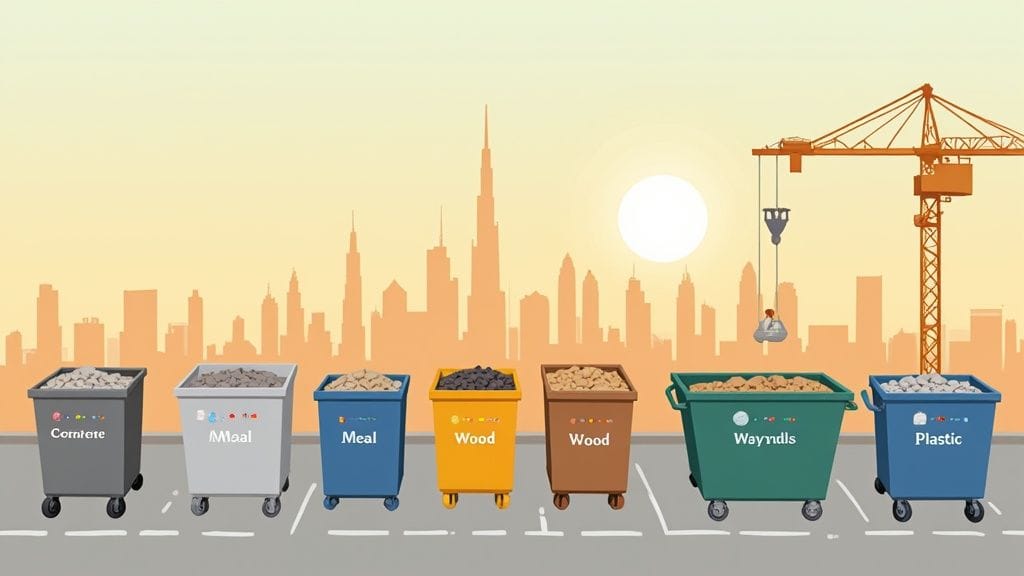
The most effective approach, hands down, is a colour-coded bin system. It’s as straightforward as it sounds: you assign a specific, brightly coloured skip or container to each major type of waste.
- Blue for Metals: This is where all your ferrous and non-ferrous metals go. Think steel rebar offcuts, aluminium framing, copper wiring, and old pipes.
- Green for Wood: Un-treated timber, scraps of plywood, and broken pallets belong here. It’s crucial to keep this wood clean from paints or chemicals to make it recyclable.
- Grey for Concrete and Masonry: This bin is for broken concrete blocks, bricks, tiles, and general rubble. This stuff is perfect for being crushed down into recycled aggregate.
- Yellow for Plastics and Packaging: This covers everything from plastic sheeting and PVC pipe offcuts to cardboard. Keeping the cardboard dry is key to preserving its recycling value.
This simple visual system takes all the guesswork out of the equation. It makes it easy for everyone, from the site foreman to the newest labourer, to put waste in the right place. A well-organised site is also a safer site, which is a critical part of project planning. You can read more about this in our complete guide to risk management in construction projects.
The 'Why' Behind Source Segregation
Putting a system like this in place isn't just about keeping the site tidy. It has direct, significant benefits—both financial and operational—that you'll feel throughout the project's entire lifecycle. The moment you start separating materials at the source, you unlock their hidden value.
A pile of mixed construction debris is a liability with a high disposal cost. A container of clean, segregated scrap metal is a valuable asset you can sell. The difference is simply effective on-site management.
Cross-contamination is the number one enemy of recycling. A single skip of wood mixed with plasterboard and plastic becomes almost worthless. It’s destined for the landfill, which means you're paying the highest disposal fees. By keeping your waste streams pure, you dramatically slash landfill costs and can even create a new revenue stream by selling the sorted recyclables.
At Freeline Engineering Consultants, we don’t just talk about these systems; we help you build them from the ground up. We work with your site teams, integrate sorting into the daily workflow, and make sure everyone is on the same page. Our operational expertise turns the theory of sustainable building into a practical, profitable reality on even the most demanding Dubai construction sites.
This hands-on approach guarantees that your commitment to responsible waste management isn't just a plan on paper, but a tangible, cost-saving process happening on your site, every single day.
Let us show you how to make on-site segregation work for your project. Contact Freeline Engineering Consultants for a practical consultation.
Using Modern Technology for Resource Recovery
Effective on-site sorting is a great start, but what happens to the materials once they leave your project? In Dubai, the journey doesn't end at the landfill. Instead, materials enter a sophisticated ecosystem of resource recovery, driven by advanced technology that turns construction debris back into valuable assets. This is where a smart approach to construction waste management really pays off, lining up perfectly with the UAE's circular economy goals.
Forget the old days of slow, manual sorting at waste facilities. Today's recovery centres in the UAE operate more like high-tech manufacturing plants. They use a powerful combination of machinery and automated systems to process mixed construction and demolition (C&D) waste with impressive speed and precision.
The Power of Automated Separation
Picture a massive conveyor belt loaded with mixed rubble—concrete, metal, wood, and plastic—entering a facility. Automated systems immediately get to work, doing things that would be impossible to do efficiently by hand.
- Powerful Magnets: Large, overhead magnetic separators pluck all ferrous metals like steel rebar and beams right out of the waste stream.
- Eddy Current Separators: These clever machines create a magnetic field that repels non-ferrous metals, effectively kicking out valuable materials like aluminium and copper.
- Air Classifiers: Think of these as industrial-strength blowers. High-pressure air jets send lighter materials like paper, cardboard, and plastic flying away from heavier ones like concrete and stone.
- Vibrating Screens: Multi-layered screens, or trommels, shake and sift the material, separating it by size into different streams for more processing.
This multi-stage process makes sure that each type of material is isolated, cleaned, and ready for its next life. The investment in this machinery is growing fast, which shows how important it is. The regional market for waste sorting equipment—which is crucial for recycling construction debris—was valued at USD 27.5 million in 2024 and is expected to grow significantly. This boom is fuelled by government policies that support the circular economy, including investments in automation to improve sorting accuracy.
From Waste to a Valuable Commodity
Once separated, these materials become valuable commodities, ready to re-enter the supply chain. This is the circular economy in action: waste is transformed back into a resource.
The ultimate goal of modern recovery technology is to close the loop—turning what was once considered rubbish into high-quality raw materials that reduce our reliance on virgin resources.
Cleaned scrap metal is melted down to create new steel products. Crushed concrete and masonry are processed into recycled aggregate, a high-quality material used for roadbeds, foundations, and even new concrete mixes. You can see how these recycled products fit into a bigger picture by reading our overview of sustainable construction materials. Even salvaged wood can be chipped and repurposed for landscaping or biofuel.
At Freeline Engineering Consultants, our strong relationships with Dubai’s leading recycling and recovery facilities are a key part of our service. We don't just help you manage waste on-site; we make sure it gets to the right facilities that use the best available technology to recover as much as possible. When you partner with us, you're plugged into the most efficient and sustainable waste solutions on the market.
Ensure your project's waste becomes a resource, not a liability. Contact Freeline Engineering Consultants to see how our tech-forward approach can benefit your bottom line.
The Financial Case for Strategic Waste Management
Effective construction waste management isn’t just another expense line on your project budget; it’s a powerful strategic investment with a clear and measurable return. Many developers in Dubai still see waste disposal as a simple cost of doing business, but this thinking misses a huge opportunity to boost profitability. When you move beyond basic compliance, you start to uncover real financial gains that directly impact your bottom line.
A smart waste strategy systematically attacks project costs from multiple angles. It starts by drastically reducing the hefty landfill fees imposed by Dubai Municipality—fees specifically designed to discourage dumping. Every single tonne of material you divert from the landfill is a direct, immediate cost saving. This is where a professional approach starts paying for itself right away.
From Site Debris to New Revenue
The real financial magic, however, happens when you start turning waste streams into new sources of income. Segregated materials aren't just rubbish; they are commodities with real market value. Clean scrap metal, for instance, can be sold to local recyclers, generating significant revenue that helps offset other project expenses.
This proactive approach to resources is a core part of successful building construction project management, where every efficiency gain contributes to the overall win. In the same way, materials like salvaged timber and even clean, sorted cardboard can be sold off, turning what was once a disposal cost into a profit centre. It’s all about a fundamental shift in perspective—seeing value where others only see waste.
The visual below breaks down how recovered materials can have a substantial financial impact when you have a well-executed strategy in place.
As you can see, focusing recovery efforts on high-volume materials like concrete, wood, and metal can lead to diverting over half of your site's waste from landfills, generating millions in annual savings.
Reducing Costs Through Material Reuse
Beyond selling off recyclables, a robust waste strategy helps lower your procurement costs by making on-site reuse possible. This is a powerful, yet often overlooked, tactic.
The most cost-effective material is the one you don't have to buy. By reusing materials you've already paid for, you can achieve substantial savings on your project's material budget.
Think about the common practice of crushing concrete and masonry rubble right on-site. This process creates high-quality recycled aggregate that’s perfect for use in roadbeds, backfilling, or as a sub-base material. This simple action knocks out two major costs: the fee for hauling the rubble away to a landfill and the expense of purchasing new virgin aggregate. Every cubic metre of aggregate you produce on-site is a direct saving.
The Financial Payoff: A Comparative Look
To truly grasp the financial upside, it helps to compare the standard "get rid of it" approach with a more strategic one. The numbers often speak for themselves.
Waste Management ROI: A Comparative Look
| Financial Factor | Standard Disposal Approach | Strategic Management Approach |
|---|---|---|
| Landfill Fees | High and unavoidable; a major operational cost. | Significantly reduced through diversion and recycling. |
| Material Sales | Zero revenue generated; materials are treated as waste. | Creates new income streams from selling scrap metal, wood, etc. |
| Procurement Costs | All materials must be purchased new, adding to the budget. | Lowered by reusing materials like crushed concrete for aggregate. |
| Regulatory Risk | Higher risk of fines for non-compliance with disposal rules. | Ensures full compliance, avoiding costly penalties. |
| Overall ROI | Negative. A pure cost centre that drains the project budget. | Positive. Becomes a profit centre that enhances the bottom line. |
The takeaway is clear: treating waste management as an integrated part of your project plan doesn't just cut costs—it actively contributes to your profitability.
The Freeline Advantage: A Partner in Profitability
At Freeline Engineering Consultants, we don’t see construction waste management as just an operational task. For us, it’s a key financial strategy. Our expertise is in designing and implementing systems that are perfectly matched to the unique demands of your Dubai project, especially for developments like residential and commercial buildings, industrial facilities, and private villas. We understand the distinct operational flows and waste generation patterns of these projects.
Our hands-on management ensures that segregation is practical, recovery is maximised, and your financial return is optimised. We build the business case directly into your project plan, showing you precisely how our involvement translates into lower disposal fees, new revenue streams, and reduced material purchasing costs. We handle all the complex logistics and documentation, allowing you to focus on your core construction activities while we protect and enhance your profit margins.
Partnering with us means elevating your project's financial performance and cementing your reputation as a leader in sustainable, intelligent development.
Choosing the Right Waste Management Partner in Dubai
Picking a partner for your construction waste management in Dubai is easily one of the most important decisions you'll make for your project. This isn't just about hauling away debris. The choice you make has a direct line to your budget, your timeline, and your legal standing.
The right firm becomes a strategic ally, turning what can be a logistical headache into a smooth, cost-effective process that protects your bottom line. A partner with deep roots in Dubai’s regulatory world is simply non-negotiable. You need someone with a proven track record of getting results on the ground, not just on paper. This goes way beyond just having the right licenses; it’s about a fundamental understanding of Dubai construction sites and the ability to prevent problems before they happen.
Core Competencies of an Ideal Partner
When you're sizing up potential firms, don't let the price tag be your only guide. Look for a partner who can show you real expertise and a genuine commitment to your project's success. This is where a company’s hands-on experience and approach make all the difference.
A top-tier partner will bring this to the table:
- Proven Regulatory Expertise: They need a deep, working knowledge of Dubai Municipality’s specific rules for waste management plans, on-site segregation, and reporting. They should be able to walk you through the approvals process without breaking a sweat.
- Operational Excellence: Look for the ability to set up practical, on-site systems that your crew can actually follow. This is key to hitting high recycling rates and keeping cross-contamination to a minimum.
- Transparent Reporting: You need clear, consistent, and audit-proof paperwork. This gives you total visibility and peace of mind when regulatory inspectors show up.
The true measure of a great waste management partner is their ability to make compliance invisible and profitability tangible. They should function as a seamless extension of your own project team, focused on efficiency and results.
Why Freeline Engineering Consultants Excels
At Freeline Engineering Consultants, we don't just tick these boxes—we embody them. With nearly three decades of experience right here in Dubai, our foundation is built on an unmatched understanding of the local construction landscape. We don't treat waste management as an add-on; we weave it into our core engineering and supervision services, creating a single, powerful strategy that boosts project value from day one.
Our approach is client-focused, meaning your project goals become our non-negotiable mission. We don't offer generic solutions. Instead, we design and implement bespoke waste management plans tailored to the unique needs of your build, whether it's a residential building, an industrial facility, or a private villa. Our expertise as consulting engineers in the UAE gives us a holistic view, ensuring that waste management enhances overall project efficiency rather than hindering it.
We stand by our results because they are proven on countless projects across Dubai. We transform regulatory burdens into opportunities for significant cost savings and elevate your project’s sustainability credentials.
Ready to see how a true strategic partner can transform your approach to construction waste management?
Don't settle for less. Contact Freeline Engineering Consultants today for a consultation and discover how our unparalleled expertise can bring immediate and lasting value to your next project.
Frequently Asked Questions
Diving into the practical side of construction waste management in Dubai always brings up a few key questions. We hear these from project managers and developers all the time, so let's tackle them head-on with some clear insights from our years of local experience.
What Is the Most Common Mistake on Dubai Construction Sites?
Without a doubt, the biggest mistake we see is failing to sort waste on-site from day one. Far too many projects treat all their waste as a single stream, tossing valuable materials like metal and wood in with general rubble and concrete.
Once everything is mixed, it's a mess. This cross-contamination makes recycling incredibly difficult and expensive. It’s a guaranteed way to pay the highest possible landfill fees instead of generating revenue from selling those sorted materials. A simple, well-managed sorting system on-site prevents this problem entirely.
How Much Can I Realistically Save with a Good Plan?
The savings can be genuinely substantial, and they come from a few different places. First, you'll see a dramatic drop in your landfill disposal fees, which can be quite costly. Second, you open up a new revenue stream by selling sorted recyclables like scrap metal.
Finally, you can lower your own procurement costs by reusing materials right on site—think crushed concrete being repurposed as aggregate. For a medium-sized project, it's not unusual to see cost reductions reaching into the tens of thousands of dirhams. That's money that goes directly back to your project's bottom line.
Effective waste management isn't just about environmental responsibility; it is a direct financial strategy. The focus shifts from a disposal cost to a value recovery opportunity, making your project more profitable.
Do I Need a Specialist for Waste Management?
While you could manage it in-house, bringing a specialist partner on board offers serious advantages. The regulatory landscape in Dubai is complex and always evolving. A specialist knows the ins and outs of Dubai Municipality’s requirements, ensuring your Waste Management Plan (WMP) gets approved quickly and your site stays compliant.
What's more, an expert partner like Freeline Engineering Consultants already has established relationships with the best recycling facilities in the region. This network ensures you get the maximum value for your recovered materials and that everything is handled responsibly. It frees up your team to do what they do best: focus on construction. Our expertise is perfectly suited to the unique challenges of both residential and commercial projects.
At Freeline Engineering Consultants, we build expert construction waste management directly into our project supervision services. This makes sure your project is not only compliant but also more efficient and profitable. Let us handle the complexities so you can focus on building.
Contact us today to learn how our specialised approach can benefit your next project.