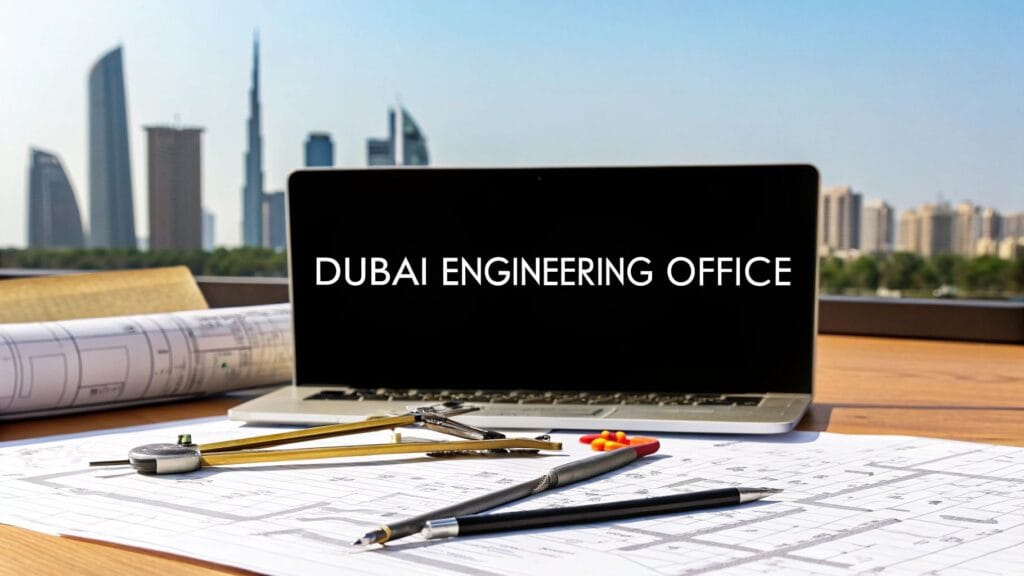
Building in Dubai is all about turning ambitious, larger-than-life visions into architectural marvels. At the very centre of this incredible process is the Dubai engineering office—the partner you absolutely need to navigate this fast-paced world. They are the master coordinator and strategic guide for your entire project, handling everything from the first design sketches and structural integrity checks to securing all the complex approvals from local authorities.
Your Guide to Dubai's Engineering Landscape
A Dubai engineering office is so much more than just a technical service provider. It’s the central nervous system of any construction project, big or small. They are the essential link between a developer's dream, the strict standards set by local authorities, and the final, physical reality of the building. Their job is to make sure every single part of the project is planned with precision, is fully compliant, and is built to perfection.
This partnership is foundational. Without an expert engineering team, even the most brilliant concepts can get bogged down by regulatory hurdles, structural miscalculations, or poor coordination between different teams. The right firm orchestrates the whole pre-construction journey, turning what could be chaos into a smooth, predictable process.
The Role of an Engineering Office
An engineering consultancy acts as your project's main technical authority. Their responsibilities are vast, covering the entire project lifecycle from a simple idea on a napkin to the final handover of the keys.
Here’s a quick look at their core functions:
- Design & Planning: They develop the architectural, structural, and MEP (Mechanical, Electrical, and Plumbing) plans that are both creative and fully compliant with local codes.
- Regulatory Navigation: They become your official representative, working to get all the necessary permits from authorities like Dubai Municipality, DEWA, and the RTA.
- Technical Oversight: Their team ensures the building's structural integrity, safety, and long-term sustainability are all up to standard.
- Project Coordination: They manage the intricate dance between all the different disciplines—architects, structural engineers, MEP specialists—to prevent clashes and delays on-site.
This integrated approach is non-negotiable. For instance, if the MEP systems aren't coordinated properly with the structural design early on, it can lead to massive, time-consuming rework during construction. A sharp engineering office sees these potential conflicts coming and solves them on paper, long before they become expensive problems on the building site. To really grasp this critical integration, you can dive deeper into our guide on MEP engineering consultants in Dubai.
Key Services from a Dubai Engineering Office
To give you a clearer picture, here’s a breakdown of the essential services you should expect from a top-tier engineering consultancy in Dubai. This table shows the sheer breadth of expertise needed to bring a project from concept to reality successfully.
| Service Category | Key Functions | Why It Matters to Your Project |
|---|---|---|
| Architectural Design | Concept development, space planning, facade design, and 3D visualisation. | This is where your vision takes shape. Good design balances aesthetics with practical functionality and local regulations. |
| Structural Engineering | Load calculations, foundation design, structural analysis, and material specification. | The absolute backbone of your building. This ensures the structure is safe, stable, and built to last against all potential stresses. |
| MEP Engineering | HVAC, electrical power, plumbing, and fire safety system design. | These are the vital systems that make a building habitable and functional. Proper integration is key to efficiency and comfort. |
| Authority Approvals | Permit applications, liaison with municipalities (DM, DDA), and utility providers (DEWA, Etisalat). | This is a major hurdle in Dubai. Expert navigation saves immense time and prevents costly delays in starting construction. |
| Project Management | Timeline scheduling, cost estimation, stakeholder coordination, and quality control. | Keeps the entire project on track, on budget, and ensures all teams are working together seamlessly towards the same goal. |
Ultimately, these services aren't just a checklist; they're an interconnected system. The success of one depends heavily on the others, which is why having a single, cohesive team managing them is a massive advantage.
Why Dubai's Construction Sector Relies on Expert Engineers
The demand for high-calibre engineering talent in the region is only getting stronger. The UAE's construction market is set to grow by 4.2% in 2025, fuelled by huge investments from both the public and private sectors. Major initiatives like Dubai’s RTA 2024-27 Main Roads Development Plan, valued at a staggering AED 15.8 billion ($4.3 billion), highlight the emirate's relentless push for world-class infrastructure. This, in turn, fuels the need for highly proficient engineering firms that can deliver.
In a city defined by architectural ambition, the engineering office is the silent partner behind every landmark. Their job is to ground soaring visions in the practical realities of physics, finance, and regulation, ensuring that what is imagined can be safely and efficiently built.
At Freeline Engineering Consultants, we live and breathe this role. We don't just design buildings; we architect success. With nearly three decades of hands-on local experience and a deep understanding of modern engineering, we make sure your project isn't just compliant—it's a benchmark for quality and innovation. Our mission is to be the firm that turns your blueprint into a landmark, navigating every challenge with precision and foresight.
The Core Engineering Services Your Project Needs
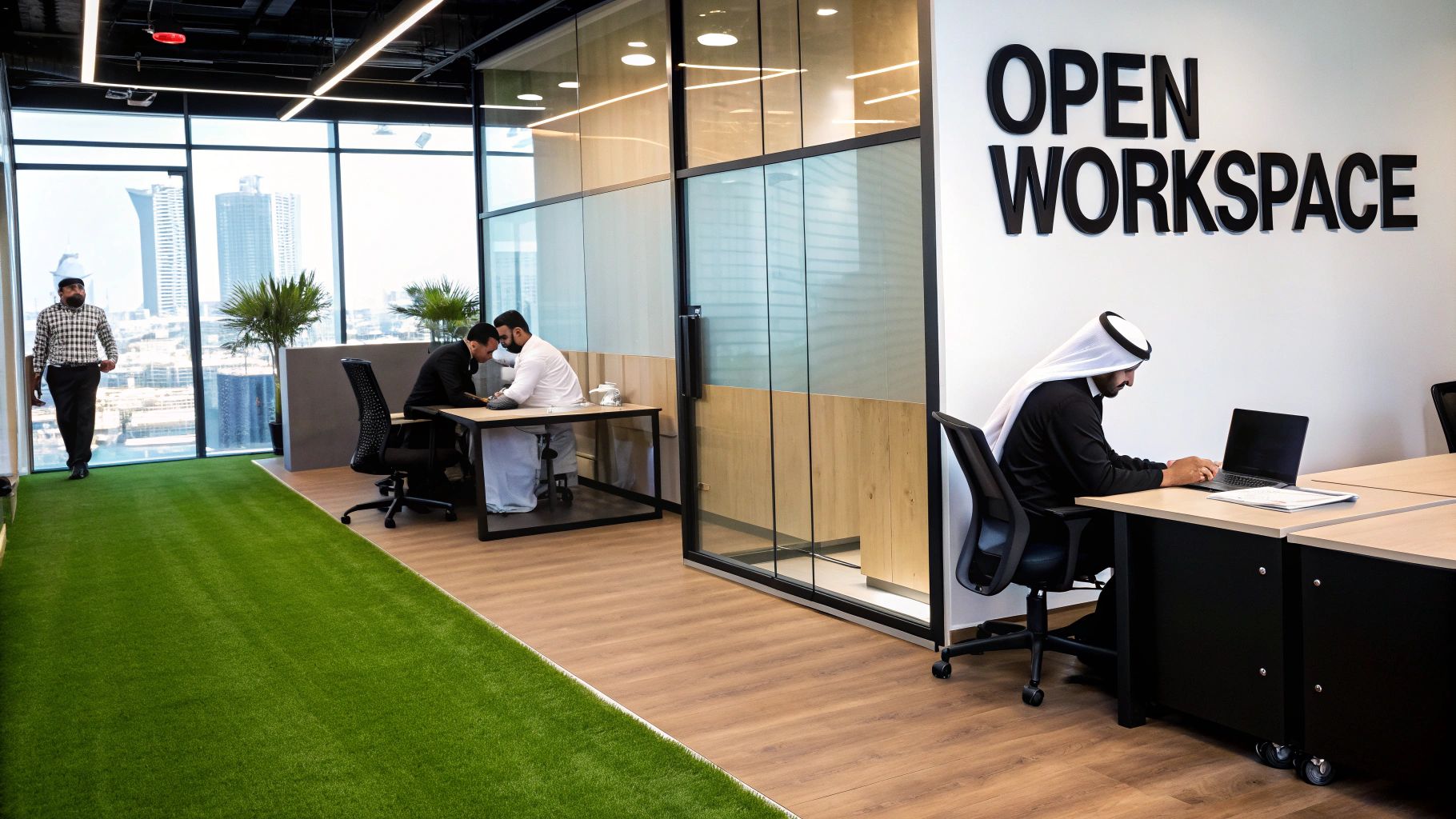
Think of a successful building project as a perfectly conducted symphony. It's a complex performance where multiple disciplines must work in flawless harmony to create something cohesive, functional, and beautiful. A top-tier Dubai engineering office is the conductor, ensuring every instrument—or in our case, every engineering service—plays its part perfectly in sync.
To really appreciate the value an integrated firm brings to the table, you first need to understand these core services. Let's peel back the technical jargon and look at the three fundamental pillars of building design.
Architectural Design: The Soul of Your Building
This is where it all begins. Architectural design is the very first step in giving your vision a physical form. It’s the building's identity, its personality, and the face it shows to the world. But it’s about so much more than a pretty facade; it’s about crafting spaces that feel inspiring while being perfectly functional for the people using them day in and day out.
You can think of it as the soul of your project. It defines the flow of movement, the quality of natural light, and the entire experience of being inside the structure. A great architect skillfully balances aesthetic dreams with the hard realities of budget, site conditions, and Dubai’s very specific building codes.
For a luxury villa, this means creating a home that feels both grand and welcoming. For a factory, it means designing a layout that drives efficiency and keeps workers safe. Our philosophy at Freeline is simple: we translate your unique vision into a tangible, compliant, and beautiful design that just works.
Structural Engineering: The Unseen Strength
If architecture provides the soul, then structural engineering is the building’s unyielding skeleton. This discipline is all about one thing: ensuring safety, stability, and durability for decades to come. Structural engineers are the silent guardians of your project, making certain the building can handle any force it might face.
Their job involves incredibly complex calculations to figure out:
- The right type and strength of foundation needed to carry the building's massive weight.
- The precise materials and dimensions for every column, beam, and slab.
- How the structure will resist environmental forces like high wind loads and potential seismic activity—both critical concerns in this region.
This is a part of the project with zero room for error. Even a tiny miscalculation can have devastating consequences. That’s why you absolutely must partner with an experienced team that has a deep, practical understanding of local ground conditions and how different materials perform in Dubai's climate.
MEP Engineering: The Vital Systems
MEP stands for Mechanical, Electrical, and Plumbing engineering. If the structure is the skeleton, MEP represents the building's vital circulatory and nervous systems. These are the active, dynamic networks that make a building comfortable, functional, and ultimately, liveable.
Let's break it down:
- Mechanical: This is primarily the Heating, Ventilation, and Air Conditioning (HVAC) system. In Dubai, a powerful and efficient HVAC system isn't a luxury; it’s essential for health and comfort. This also covers vital fire safety and suppression systems.
- Electrical: This covers everything from the main power distribution down to the lighting, data cables, and security systems. Good electrical design delivers reliable power and prevents dangerous system overloads.
- Plumbing: This involves the complex network for supplying clean water, efficiently removing wastewater, and managing drainage and sanitation.
A building can have a stunning design and a rock-solid structure, but without perfectly integrated MEP systems, it is merely an empty shell. The true measure of a building's success lies in how seamlessly these vital systems support the daily lives of its occupants.
The real challenge—and where many projects stumble—is getting these three core services to work together. When architecture, structural, and MEP designs are created in isolation, the result is almost always chaos on-site. You'll find an air duct planned to run straight through a structural beam, or plumbing lines clashing with electrical conduits. These clashes cause costly rework, major project delays, and a mountain of frustration.
This is the exact problem an integrated Dubai engineering office like Freeline is built to solve. By having our architectural, structural, and MEP teams collaborating under one roof from day one, we design in harmony. We iron out all the potential clashes on paper, long before they become expensive problems on the construction site. This single point of accountability is what makes the difference between a smooth, efficient project and a chaotic, stressful one.
To get the full picture, you can explore the comprehensive scope of services our engineering consultants in Dubai provide.
How to Select the Right Engineering Partner
Choosing your engineering partner is easily the most critical decision you'll make for your project. This isn't just about hiring someone to draw up blueprints; it's about finding a strategic ally who will protect your investment, your schedule, and your overall vision from day one until completion. Get it right, and your project will flow smoothly. Get it wrong, and you could be facing costly delays, budget blowouts, and a whole world of regulatory headaches.
This decision is especially crucial in a market as dynamic and demanding as Dubai's. The UAE's engineering services market is on a steep upward curve, with a projected compound annual growth rate (CAGR) of 5.8% between 2025 and 2030. In 2024, the consulting segment alone accounted for a massive 21.63% of this market, which tells you just how central the role of a Dubai engineering office is. You can dig deeper into this trend, which mirrors the UAE's broader push towards a knowledge-based economy, over at Grand View Research.
Proven Local Expertise and Regulatory Mastery
When you're vetting potential partners, your first non-negotiable has to be their deep, hands-on experience right here in Dubai. This is about so much more than just knowing the building codes. A truly experienced local firm understands the unwritten rules, the specific nuances, and the preferences of key authorities like Dubai Municipality (DM), DEWA, and the RTA.
This kind of local intelligence is priceless. It means they can anticipate potential roadblocks, prepare submissions that sail through approvals on the first go, and use their established relationships to sort out any issues that pop up. A firm that's learning the local landscape on your project’s time is a risk you simply can’t afford to take. At Freeline, our nearly 30 years of exclusive Dubai focus gives us an unparalleled advantage in this arena.
Analyse the Portfolio for Problem-Solving
Every engineering firm will have a portfolio, but you need to learn to look beyond the glossy photos of completed buildings. Your real mission is to analyse their past work for evidence of complex problem-solving. A portfolio full of straightforward, cookie-cutter projects might look polished, but it doesn't show you if they can handle the curveballs that construction projects inevitably throw.
Look for projects that reveal:
- Complex Site Conditions: Did they successfully build on a difficult or constrained piece of land?
- Technical Integration: Can you see how seamlessly they coordinated MEP, structural, and architectural elements?
- Innovative Solutions: Did they face a unique design challenge and overcome it with a clever, out-of-the-box engineering fix?
A strong portfolio isn't just a gallery; it's a track record of overcoming adversity. It's the proof you need that the firm has the technical depth and creative horsepower to keep your project on track, no matter what hurdles appear.
The Litmus Test: A Fully Integrated Team
One of the biggest culprits behind project delays and budget overruns is poor coordination between the different engineering disciplines. When you hire separate firms for architecture, structural design, and MEP, you’re often stuck playing the role of the middleman, trying to get everyone on the same page.
A truly effective engineering partner operates as a single, cohesive unit. This integrated approach ensures that from the very first sketch, every system is designed in harmony, eliminating the on-site clashes that can derail a project's timeline and budget.
This is the standard we live by at Freeline Engineering. Our in-house teams collaborate from the very beginning, ensuring every last detail is perfectly aligned. We believe this single point of accountability is the absolute cornerstone of a successful project, giving our clients total peace of mind and predictable, positive outcomes.
Ultimately, picking the right partner means finding a firm that acts as a true extension of your own team. They should be transparent, responsive, and completely invested in your success. If you're looking for more guidance, read our detailed overview of what a premier engineering office in Dubai should deliver for your project.
Navigating the Dubai Authority Approvals Process
Bringing a construction project to life in Dubai is more than just having a groundbreaking design; it's about successfully navigating a detailed regulatory maze. Securing permits from the key authorities is a critical phase, and frankly, it's where many projects either build momentum or get bogged down in expensive, time-consuming revisions. This isn't a sprint. It's a marathon that requires absolute precision, foresight, and an intimate knowledge of local processes.
You can think of the approvals process as a series of essential checkpoints. Each one is overseen by a different authority, and each has its own unique set of rules. Your project needs the green light from entities like the Dubai Municipality (DM), Dubai Electricity and Water Authority (DEWA), the Roads and Transport Authority (RTA), and Dubai Civil Defence (DCD), just to name a few. Every single step, from the initial No Objection Certificate (NOC) to the final Building Completion Certificate (BCC), demands flawless documentation and designs that are perfectly in line with local by-laws.
The Approval Workflow From Design to Completion
The journey to getting a project fully approved follows a very structured, step-by-step workflow. A top-tier Dubai engineering office doesn't just walk this path; it manages it proactively, anticipating what's needed next and clearing roadblocks before they can become genuine problems. The process typically involves submitting detailed architectural, structural, and MEP drawings for review at several key stages.
This visual below gives you a clear idea of the core project phases, which run alongside the authority approvals timeline.
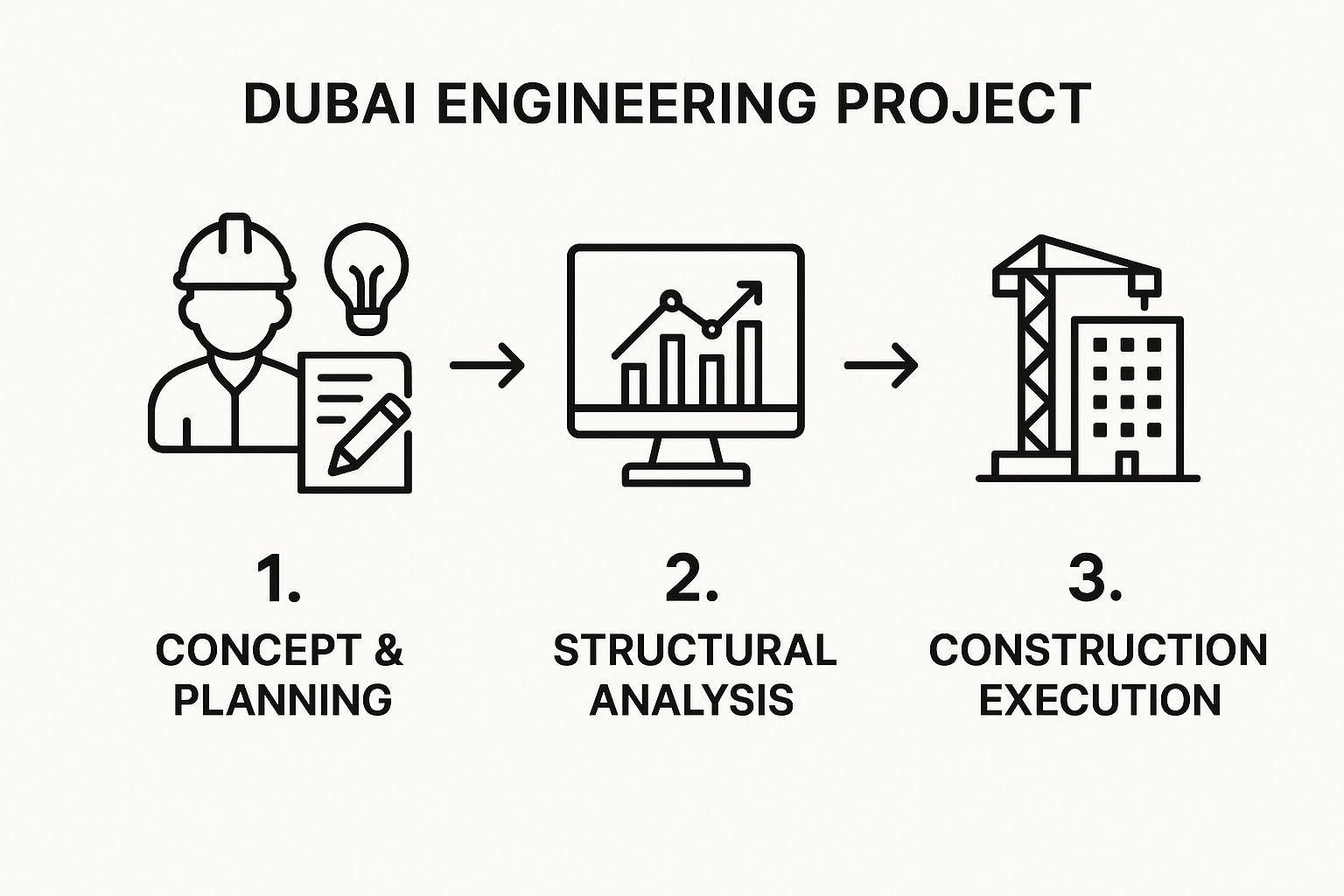
As you can see, construction is the final piece of the puzzle. It only happens after all the rigorous planning and analysis have been completed, checked, and officially approved.
Common Pitfalls and How an Expert Firm Avoids Them
Far too many projects hit a wall during the approvals stage because of simple, avoidable mistakes. These missteps can bring progress to a grinding halt for months, blow up the budget, and cause a huge amount of stress for developers and owners alike.
Some of the most common pitfalls we see include:
- Incomplete or Inaccurate Drawings: Submitting plans with missing information or conflicting details is the surest way to get a rejection notice from Dubai Municipality.
- Non-Compliant Designs: A design might look fantastic on paper, but if it breaks a specific building code or a DEWA regulation, it's getting sent right back.
- Poor Coordination: When the architectural plans don’t match up with the MEP or structural drawings, the authorities will spot those gaps immediately.
- Lack of Follow-up: The submission process isn't a "set it and forget it" task. It requires constant, diligent communication with authority representatives—something a busy developer simply may not have time for.
An experienced engineering consultant turns this potential bottleneck into a streamlined advantage. Their real value isn’t just in creating compliant designs; it's in their ability to manage the entire submission process with an insider's grasp of how each authority thinks and operates.
This is where the Freeline Engineering advantage really shines. We don't just wait for feedback from the authorities; we work to prevent it from being necessary in the first place. Our teams perform painstaking internal reviews before a single document leaves our office, making sure every detail is correct and fully compliant. Our deep familiarity with the specific nuances of each department means we prepare submissions that are built for first-time approval. For a closer look at this crucial process, you can explore our detailed guide on the Dubai Municipality approval process.
Our proactive approach is designed to protect your two most valuable assets: your project timeline and your budget. By cutting down on revisions and speeding up the permit process, we make sure your project moves from blueprint to reality without those frustrating and costly delays. This careful management is what separates a standard service provider from a true project partner.
When you partner with Freeline, you’re putting your project in the hands of a team that has been successfully navigating this complex landscape for nearly 30 years. We take care of the bureaucratic heavy lifting so you can stay focused on your vision.
The Freeline Advantage: Your Strategic Partner in Dubai
Choosing a Dubai engineering office isn't just a simple transaction. It's the start of a partnership that will ultimately decide whether your project soars or struggles. Behind the technical drawings and endless calculations is the real core of a successful build: a relationship based on trust, aligned goals, and a genuine commitment to bringing your vision to life. This is precisely where Freeline Engineering Consultants steps beyond the typical consultant role to become your dedicated strategic partner.
We get it. You aren’t just putting up a building; you're investing a huge amount of capital, time, and ambition into a physical asset. Our whole philosophy is built around that reality. We treat your project with the same focus and dedication we’d give our own, making sure every single decision is made with your best interests front and centre. This client-first approach is the bedrock of the Freeline advantage.
More Than a Consultant, A True Project Partner
Let's be honest, many firms can produce a set of compliant blueprints. That’s the baseline. A true partner, however, adds real value at every single stage, from the first napkin sketch to the final project handover. Our job is to protect your investment by delivering technical excellence, maintaining strict budget discipline, and guaranteeing schedule certainty.
How do we do this? With a solid track record of managing and delivering complex projects on time and within their financial scope. Our process is designed to be completely transparent and collaborative, which keeps you informed and empowered every step of the way. We see ourselves as an extension of your own team, providing the technical muscle and local know-how needed to turn big ideas into profitable realities. This integrated method is more than just coordination; it’s a true fusion of different disciplines, a topic we dive into deeper when explaining what a leading architecture consultant company really provides.
A Legacy of Excellence and Innovation
For nearly three decades, Freeline has been a constant in Dubai's ever-evolving skyline. Our longevity speaks for itself—it’s proof of our adaptability, our deep technical skill, and our unwavering commitment to quality. We mix this deep-rooted local experience with a forward-thinking mindset when it comes to design and engineering.
We are champions of sustainable building practices and innovative solutions that not only meet today's tough standards but also look ahead to the needs of tomorrow. This blend of tradition and progress is what makes us such a powerful ally for any construction project in the region.
Why Freeline is the Best Choice for Your Project
To really grasp the value we bring to the table, a side-by-side comparison can be helpful. The table below lays out the tangible benefits of partnering with Freeline instead of a standard engineering firm.
| Feature | Standard Engineering Office | The Freeline Engineering Advantage |
|---|---|---|
| Approach | Transactional; delivers services as requested. | Partnership-driven; acts as a strategic advisor invested in your success. |
| Coordination | Often requires the client to manage separate disciplines. | Fully integrated in-house teams for seamless, clash-free design. |
| Problem Solving | Reactive; addresses issues as they come up. | Proactive; anticipates challenges and solves them before they impact the project. |
| Authority Approvals | Follows standard submission procedures. | Leverages deep local relationships and knowledge for faster, more efficient approvals. |
| Accountability | Multiple points of contact can lead to confusion. | A single, accountable partner simplifies communication and ensures clarity. |
This comparison makes our core message crystal clear: Freeline isn't just another name on a list of vendors. We are a dedicated partner, fully committed to making your vision a reality with unmatched technical skill and invaluable local insight.
Frequently Asked Questions
Taking on a construction project in Dubai is an exciting prospect, but it naturally comes with a lot of questions. It's a complex environment, but a rewarding one, and getting clear answers from the very start is key to a smooth journey. Here, we tackle some of the most common queries we get from clients, offering practical insights that show why partnering with an experienced Dubai engineering office makes all the difference.
How Long Does the Authority Approval Process Take in Dubai?
This is always a critical question, as the timeline directly impacts when you can break ground. The honest answer is: it varies. The project's scale and complexity are the biggest factors.
For something straightforward like a G+1 villa, you can generally expect the approval process to take somewhere between two to four months. But for larger, more intricate structures—like a multi-storey residential building or a specialized industrial facility—that timeline can easily stretch from six to twelve months, or sometimes even longer.
The single most important element influencing this schedule is the quality of your initial submission. Handing over a fully compliant, meticulously detailed, and clash-free design package right from the get-go is absolutely essential.
An experienced engineering office doesn't just submit paperwork; they submit solutions. Firms like Freeline anticipate what the authorities need to see and have established relationships that help navigate the process. This approach significantly cuts down on the back-and-forth review cycles that can stall a project.
What Are the Most Common Project Delays and How Are They Avoided?
Project delays are more than just frustrating; they're expensive. The good news is that the most common culprits are surprisingly preventable. They usually boil down to three things:
- Incomplete Design Submissions: Plans that are missing key details will be flagged immediately by authorities. This kicks off a cycle of rejection, revision, and resubmission that eats up valuable time.
- Poor Interdisciplinary Coordination: When architectural, structural, and MEP designs aren't perfectly in sync, you get on-site clashes. This means stopping work, costly rework, and a stalled project.
- Mid-Project Scope Changes: Deciding to make frequent changes after approvals are already in hand can force you to apply for new permits, adding major delays and costs.
The best way to sidestep these issues is to work with an integrated consultancy that handles all the core services under one roof. At Freeline, our architectural, structural, and MEP teams collaborate from day one. This ensures we create a single, cohesive design that's free of clashes right from the start. We also run tough internal reviews before any submission to guarantee full compliance, drastically lowering the risk of regulatory hold-ups.
Why Is Local Experience So Crucial for an Engineering Office?
In Dubai, "local experience" means so much more than just knowing the building codes. It's about a deep, practical understanding of how things actually get done here. This "local intelligence" is invaluable and shows up in a few key ways.
- Navigating Unwritten Rules: An experienced firm knows the specific nuances and expectations of different government authorities, which often go beyond what's written in the official rulebook.
- Understanding Environmental Factors: A team with deep roots in Dubai knows exactly how to design for our unique climate and soil conditions. This ensures the building isn't just beautiful, but also durable and sustainable for the long term.
- Established Relationships: Working in the emirate for decades builds trusted relationships with authority representatives. These connections can be instrumental in getting quick clarifications and resolving issues without delay.
A firm like Freeline, with nearly three decades of dedicated Dubai experience, brings this vital intelligence to every single project. It leads to smarter designs, faster approvals, and a building that is perfectly suited to its environment.
What Is the Difference Between an Engineering Consultant and a Contractor?
It’s easy to get these two roles confused, but it's essential to understand their distinct parts in your project. A simple way to think about it is: the consultant designs the "what," and the contractor builds the "how."
The engineering consultant, like Freeline, is your partner during the design stage. We're the architects and engineers who create the detailed blueprints, run the structural analysis, design the MEP systems, and—most importantly—secure all the authority approvals needed to make your project legal and ready to build. Our main job is to transform your vision into a compliant, buildable plan.
The contractor takes over for the construction phase. They are the builders who take our approved designs and physically construct the project. They manage the workforce, the materials, and all the on-site logistics required to bring the blueprints to life.
Even after construction begins, the engineering consultant usually stays involved in a supervisory role. We act as your technical expert on the ground, making sure the contractor is following the approved plans precisely and meeting all the required quality standards. This oversight protects your investment and ensures the final building is exactly what you envisioned.
Ready to transform your vision into a Dubai landmark with a partner who understands the landscape inside and out? Freeline Engineering Consultants combines nearly 30 years of local expertise with a client-first philosophy to deliver projects with integrity and excellence. Our integrated team is the strategic advantage you need to ensure your project is a success from blueprint to reality.
Contact us today for a consultation and experience the Freeline advantage.