What if you could make your construction project better and more cost-effective at the same time? That’s the real heart of value engineering in construction. It’s not about finding the cheapest way out; it’s a smart, creative process focused on getting the absolute best function for every dirham spent, especially in a dynamic market like Dubai.
Unlocking Value Beyond Simple Cost Cutting
In a dynamic landscape like Dubai, just delivering a project on time and within budget is the bare minimum. Real success is measured by the long-term value you create. This is where value engineering shines, transforming from a simple cost-cutting exercise into a powerful tool for intelligent investment.
Think of it like a master chef perfecting a signature dish. They don’t just slash expensive ingredients to save money. Instead, they analyze the function of each one—what flavor, texture, or aroma does it bring? From there, they might discover a better, more efficient ingredient or a new technique that actually improves the final plate. That’s exactly how we approach value engineering for building projects in Dubai.
A Focus on Function and Performance
The process is all about a structured analysis of every single component, from the foundation to the final finishes. We start asking different kinds of questions, shifting the perspective from “What does the blueprint say?” to “What does this part need to do?”
This function-first mindset opens up a world of smarter solutions. It’s especially effective for the kinds of projects that form the backbone of Dubai’s communities—like residential buildings, hotels, and commercial centers up to G+12. In these structures, we find huge opportunities to improve efficiency without sacrificing the architect’s vision or the building’s quality. This methodical examination is a cornerstone of good planning and project success.
Why It Matters in Dubai
Dubai’s market is demanding. It requires both exceptional quality and impressive efficiency. A project’s true success isn’t just its initial price tag but its operational costs, durability, and how happy its occupants are over its entire lifespan.
Value engineering is a collaborative discipline that weighs the function-to-cost ratio of every project element. The goal is to make informed suggestions for alternate methods, designs, or materials that improve the project’s overall value, not just reduce its initial price tag.
By bringing value engineering into the picture early on, developers see some major benefits:
- Reduced Life-Cycle Costs: Making smart choices on systems like HVAC and lighting, tailored for Dubai’s climate, can lead to massive long-term savings on energy and maintenance.
- Enhanced Building Performance: Better material selections and construction methods result in a building that is more durable and functions better for its users.
- Stronger ROI: A building that costs less to run and maintain while performing at a higher level naturally delivers a much better return on investment.
At Freeline Engineering Consultants, this philosophy is built into everything we do. We have a deep understanding of the specific codes, material supply chains, and environmental challenges that are unique to Dubai. Our expertise helps us guide clients toward innovative solutions that create lasting value, proving that the best investment is one engineered for excellence from the ground up.
Understanding the Value Engineering Framework
Value engineering isn’t a single action or a last-minute cost-cutting exercise; it’s a structured journey. Think of it as a systematic process designed to analyze and boost value at every single stage of a construction project. Instead of just rubber-stamping initial designs, this framework breaks the entire project down into its core functions to find smarter, more efficient solutions.
This isn’t about abstract theory. It’s a clear, multi-phase methodology where each step builds on the last, ensuring every decision is backed by solid analysis and creative problem-solving. It’s a collaborative effort that has a knack for uncovering powerful alternatives that traditional planning often misses.
The Information Gathering Phase
The first step is all about data. This foundational phase is a deep dive into the project’s specs, design plans, budget, and ultimate goals. We aren’t just looking at what is being built, but digging into the why behind it.
For a G+10 residential tower in Dubai, for instance, this means gathering far more than just architectural drawings. We’re analyzing local building codes, current material availability, and the client’s specific goals for long-term operational costs. Getting this full picture at the start is crucial—it prevents us from making superficial suggestions later on and gives us the clarity needed for a truly meaningful analysis.
Function Analysis and Creative Brainstorming
With all the information in hand, we get to the heart of value engineering in construction: Function Analysis. This is where we shift our focus from looking at components to understanding their purpose. So, instead of simply accepting a specified HVAC system, we ask, “What is the most efficient and reliable way to cool this particular building in Dubai’s climate?”
That one question kicks off the Creative Brainstorming phase, where no idea is a bad idea. The whole team—architects, engineers, cost consultants—gets together to explore every possibility. Could a different building orientation dramatically reduce solar gain and lower cooling demands? Are there newer, high-performance insulation materials perfectly suited for this region that we haven’t considered?
This is the point where analysis sparks creativity, leading to tangible solutions.
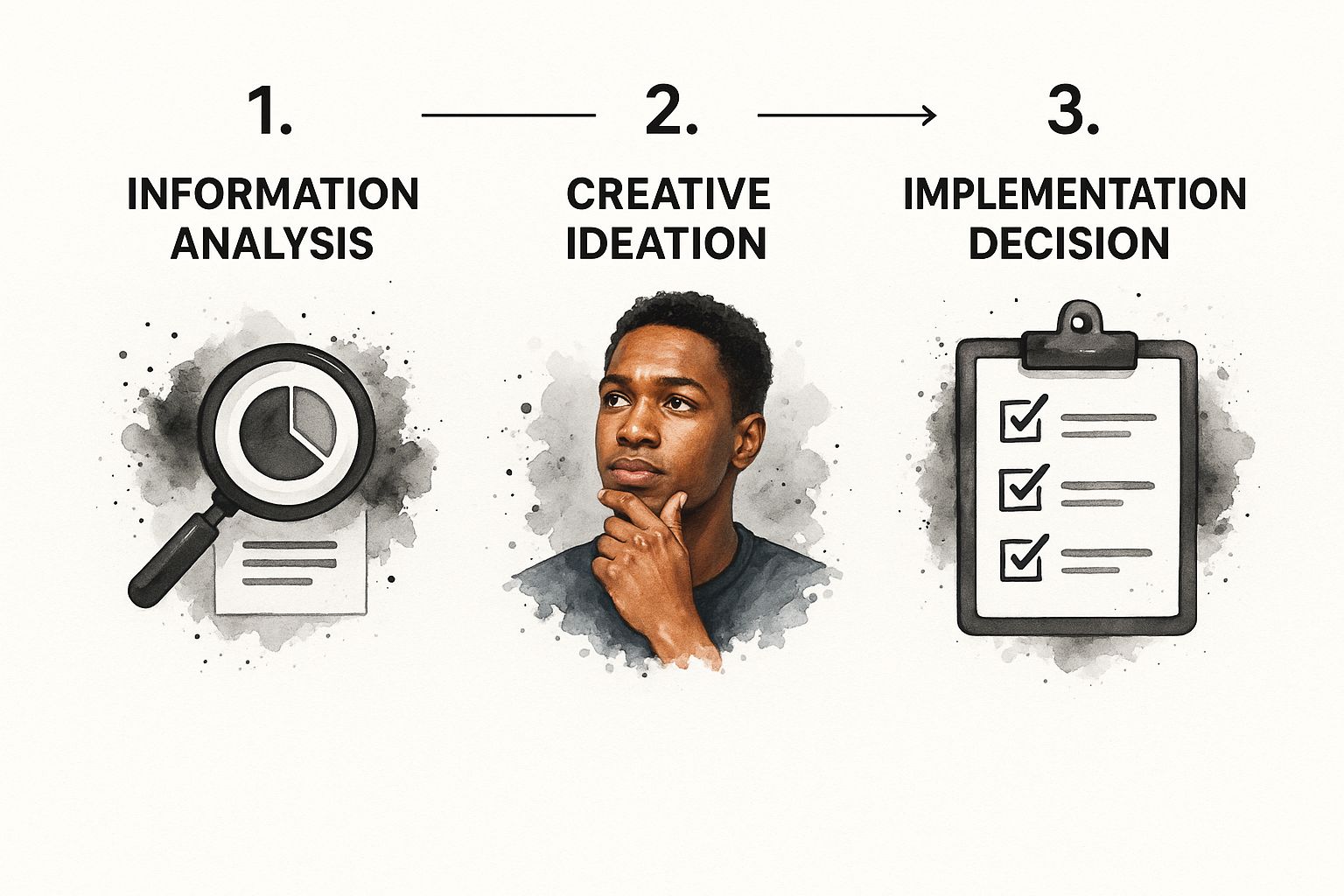
As you can see, value engineering is a logical flow. It moves from understanding the core problem to developing and ultimately selecting the best possible solution.
Evaluation and Development
Of course, a flood of great ideas needs to be filtered. That’s where the Evaluation phase comes in. Every potential solution is put under the microscope and measured against a few critical criteria:
- Feasibility: Can we actually build this with the technology and expertise available in Dubai?
- Cost-Effectiveness: Does this option offer a better value proposition, looking at both the upfront investment and the long-term life-cycle costs?
- Performance Impact: Will this change maintain—or, even better, improve—the building’s quality, safety, and functionality?
At Freeline Engineering Consultants, we treat this phase with meticulous care. Our deep knowledge of the Dubai construction landscape allows us to quickly vet ideas, discarding impractical concepts and advancing those with genuine potential. We ensure that every recommendation aligns with local codes and the project’s core vision.
The most promising alternatives then move into the Development phase. Here, we flesh out the concepts into detailed, actionable plans. We create updated specifications, prepare new cost analyses, and map out implementation strategies. This gives project stakeholders a clear, well-researched case for making the final call, ensuring every choice adds tangible, measurable value.
Realizing the Tangible Benefits for Your Project
When you hear value engineering in construction, it’s easy to think it’s just about cutting costs. But the reality is so much bigger than that. While saving money upfront is a great perk, the real power of this process unfolds over the entire life of the building.
It’s a strategic investment that pays dividends long after the construction crews have packed up. In a competitive market like Dubai, these long-term advantages aren’t just nice to have—they are essential for a project’s profitability and success. It’s the difference between a building that’s simply built and one that’s intelligently designed for performance.
Lowering Life-Cycle Costs
One of the biggest wins from value engineering is the massive reduction in life-cycle costs. This isn’t just about the initial price tag. It’s about looking at the total cost of ownership, from day-to-day operations and maintenance right through to eventual system replacements. For a climate like Dubai’s, where operational costs can really stack up, this is a game-changer.
Imagine a standard design for a G+8 residential tower specifies a certain type of exterior cladding. A value engineering workshop would dive deep into its primary functions: insulation, weather protection, and aesthetics. The team might then find a high-performance alternative that, while slightly more expensive today, offers far superior thermal insulation.
This one change has a ripple effect:
- Reduced Energy Consumption: The building needs less power for cooling, leading to significantly lower utility bills for decades.
- Lower Maintenance Needs: The more durable material might need less frequent cleaning or repairs, saving a fortune in long-term upkeep.
By focusing on the total cost, we ensure a building isn’t just affordable to construct but also economical to run.
Enhancing Building Performance and Sustainability
Value engineering also directly leads to a higher-performing, more sustainable building. When every component is scrutinized, you uncover opportunities to boost functionality, durability, and even occupant comfort. It’s a systematic way to make sure the final structure operates at its absolute best.
This approach is crucial for aligning projects with the UAE’s ambitious national goals. In the Gulf region, value engineering is becoming essential as we see more massive developments tied to long-term plans like the Dubai 2040 Urban Master Plan. Proper implementation can significantly reduce project costs while also driving demand for high-value, sustainable solutions.
Value engineering is not about compromise; it’s about optimization. It systematically enhances a project’s worth by ensuring every dirham spent delivers the maximum possible function, performance, and durability over the long run.
This focus on optimization is a natural pathway to better sustainability ratings. Whether it’s choosing more efficient MEP systems, sourcing local materials with less embodied carbon, or designing a better building envelope, value engineering helps projects achieve higher green building standards, which is increasingly important in Dubai’s regulatory environment.
Accelerating Project Timelines
Here’s a benefit that often gets overlooked: value engineering can actually speed up your project. When done early in the design phase, the process can uncover more efficient construction methods or materials that are simply faster and easier to install.
Think about a new hotel project. A VE study might suggest using prefabricated modular bathroom pods instead of building them all from scratch on-site. The material cost could be similar, but the advantages are huge:
- Faster Installation: The pods are built off-site in a controlled factory setting and then just craned into place, dramatically cutting on-site labor time.
- Improved Quality Control: Factory production means a higher and more consistent level of quality than you can get on a busy construction site.
- Reduced Site Congestion: With fewer trades needed on-site at the same time, the whole work environment becomes safer and more organized.
These efficiencies mean a shorter construction schedule. For developers, that means getting the property to market faster and starting to generate revenue sooner. At Freeline Engineering Consultants, we integrate this forward-thinking approach to ensure every project is optimized for speed, cost, and quality.
Your Guide to a Successful VE Workshop
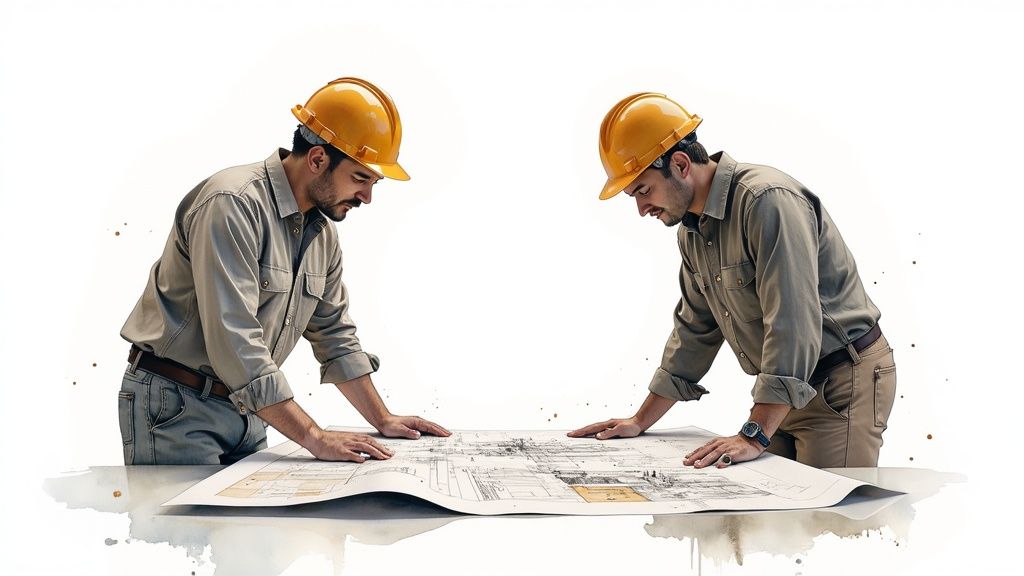
Putting value engineering in construction into practice isn’t something that just happens. It’s a focused, collaborative effort, and it all revolves around a well-organized workshop. This intensive session is the engine room of the whole process—it’s where ideas are born, challenged, and refined into real strategies that deliver maximum value.
Think of the VE workshop as a strategic summit for your project. Its success hinges entirely on getting the right people in the room, setting the right agenda, and picking the right moment. A poorly planned session can easily turn into aimless chatter, but a well-structured one can unlock huge savings and performance boosts, paving the way for a standout project in Dubai.
Assembling Your Value Engineering Team
The first rule for a successful workshop is simple: get the right minds around the table. A diverse team guarantees a 360-degree view of the project, which helps prevent blind spots and uncovers opportunities that a single specialist might overlook. Every person brings a unique perspective, and that’s essential for a truly holistic review.
For any Dubai-based project, your core team should really include:
- The Project Owner or a Representative: This is the person who holds the ultimate vision and project goals, making sure every VE proposal aligns with the core business objectives.
- Architects and Design Consultants: As guardians of the design intent and aesthetics, their input is vital. They ensure that any value enhancements don’t come at the cost of the project’s architectural soul.
- Key Engineers (Structural and MEP): These are your technical experts. They offer deep insights into the building’s core systems, and their knowledge is absolutely critical for judging the feasibility of any proposed changes—a key part of effective MEP engineering in Dubai.
- The Main Contractor or a Cost Consultant: This role provides a much-needed reality check. They bring real-world perspective on constructability, local material costs, and labor availability in the UAE market.
- A Facility or Operations Manager: This person brings the long-term view. Their feedback on maintenance, durability, and operational costs is priceless for understanding life-cycle value.
By bringing all these stakeholders together, you create a dynamic where creativity is balanced by pure practicality. It ensures every idea that comes up is not just innovative but also viable.
Pinpointing the Ideal Timing
When it comes to value engineering, timing is everything. While you can technically apply VE at any point, its impact is always greatest when it’s done early. The sweet spot is during the design development phase—after the initial concept is locked in but before the construction documents are finalized.
Conducting the VE workshop during the design phase allows for the greatest flexibility. At this stage, making significant changes to systems or materials is far less disruptive and costly than attempting to alter course once construction has begun.
Wait too long, and you shrink the potential for any real impact. Changes made mid-construction often lead to expensive rework, schedule delays, and a whole lot of friction among the team. An early-stage workshop transforms value engineering from a last-minute cost-cutting panic into a strategic tool for genuine project optimization.
Structuring a Productive Workshop Agenda
A productive workshop isn’t just a meeting; it’s a facilitated problem-solving session that needs a clear roadmap. At Freeline Engineering Consultants, we champion a structured, multi-step approach to make sure the time spent together leads to solid outcomes.
This table provides a high-level look at how VE actions align with the broader project schedule.
Value Engineering Implementation Timeline
| Project Stage | VE Action | Key Objective |
|---|---|---|
| Concept Design | Pre-Workshop Analysis | Gather all project data, identify high-cost areas, and define key project functions and goals. |
| Design Development | Full VE Workshop | Conduct the multi-phase workshop (Information, Creative, Evaluation) to generate and vet value proposals. |
| Construction Documents | Proposal Integration | Incorporate approved VE changes into the final design documents and specifications. |
| Construction Phase | Implementation & Monitoring | Oversee the application of VE solutions on-site and track their performance and cost impact. |
| Post-Occupancy | Performance Review | Evaluate the long-term success of VE decisions by analyzing operational costs and user feedback. |
A structured agenda keeps everyone focused and moving forward. Here’s a proven framework that breaks the workshop down into clear, manageable steps:
- Information Phase: Kick things off by reviewing all project documents, goals, and constraints. The facilitator makes sure everyone starts on the same page with a shared understanding of the project’s status.
- Function Analysis: This is where the real creativity begins. The team breaks down key components into their most basic functions. Instead of talking about a “wall,” you discuss its functions: “provide structural support,” “offer thermal insulation,” or “create an acoustic barrier.”
- Creative Brainstorming: With functions defined, it’s time to brainstorm alternative ways to achieve them. This is a “no bad ideas” zone focused on generating a wide range of possibilities. Could a different material offer better insulation for less? Is there a more efficient structural system for a G+12 building?
- Evaluation and Scoring: Now, the team gets critical. Each idea is systematically judged against criteria like cost, performance, and risk. Ideas are scored and ranked to see which ones have the most promise.
- Development and Recommendation: The top-ranked ideas are then fleshed out into concrete proposals. The team develops preliminary cost estimates, sketches, and a clear “why” for each recommendation.
- Presentation and Action Plan: Finally, the VE team presents its findings to the project owner. This includes a formal report detailing the proposed changes, potential savings, and an implementation plan, giving stakeholders the confidence to make smart, value-driven decisions.
Finding the Right Value Engineering Partner in Dubai
Choosing the right team is probably the most important decision you’ll make when it comes to unlocking the benefits of value engineering in construction. The methodology itself is solid, but its success hinges entirely on the expertise, local knowledge, and collaborative spirit of the people driving it. This isn’t just about marking up blueprints; it’s about deeply understanding the unique challenges and opportunities that come with building in Dubai’s fast-paced market.
At Freeline Engineering Consultants, we don’t just practice value engineering—we specialize in applying it right here in this environment. We’ve honed our focus on projects up to the G+12 scale, which really is the backbone of Dubai’s urban landscape. That kind of specialization gives us insights that a more generalized firm simply can’t offer.
We Know Dubai Inside and Out
Our team’s biggest asset is a genuine, boots-on-the-ground understanding of how to get things built in Dubai. We’re not just talking about a casual familiarity with the rules. We’ve spent decades navigating complex regional building codes, forging strong relationships with local authorities, and mastering the approval processes that can easily bog down less experienced teams.
This local know-how is also crucial when it comes to the supply chain. We know which materials hold up best in the UAE’s demanding climate, where to source them for the best price, and how to get ahead of logistical hurdles. This practical intelligence is the foundation of our value engineering process, ensuring our suggestions aren’t just good on paper—they’re practical and achievable in the real world.
Our approach is built on a foundation of collaboration, not confrontation. We respect the architect’s vision and work alongside the design team as a strategic partner, dedicated to finding smarter, more efficient ways to bring their concept to life without compromising its integrity.
In the UAE and across the GCC, value engineering is more important than ever. Massive urbanization and strategic mega-projects are everywhere. With a growing population driving the need for new infrastructure and national goals like the Dubai 2040 Urban Master Plan, development has to be smarter and more cost-efficient. As a leading Dubai engineering office, our work directly supports these ambitions by delivering optimized, high-value projects. You can learn more about how we help clients succeed by reading about what a Dubai engineering office does.
Let’s Maximize Your Project’s Value
Your next construction project deserves more than just a consultant. It needs a dedicated partner in Dubai who is committed to maximizing value from every possible angle. At Freeline Engineering Consultants, we bring the local insight, collaborative mindset, and specialized experience in G+12 projects that turn value engineering from an academic exercise into a true driver of success.
We are the ideal firm to guide your project because we combine deep technical expertise with an unparalleled understanding of Dubai’s specific construction environment. Don’t leave value on the table. Let’s talk about your project and explore how our specialized value engineering services can help you achieve outstanding results—a building that’s not just cost-effective to build, but efficient to operate for years to come.
Contact our team today to schedule a consultation and build smarter, not just harder.
Common Questions About Value Engineering
As you think about bringing value engineering in construction to your next project, it’s normal to have a few questions. This powerful approach can seem a bit complex at first, and there are definitely some common myths out there. To help clear things up, we’ve put together answers to the questions we hear most often from our clients here in Dubai.
Our goal is to give you honest, straightforward answers that take the mystery out of the process. Understanding these points will help you see value engineering for what it is: not an extra complication, but a smart strategy for getting a better result.
Is Value Engineering Just a Fancy Term for Cost Cutting?
This is probably the biggest misconception in the entire industry. While saving money is often a great outcome of the process, real value engineering is completely different from just slashing costs. It’s a method focused on getting the best possible function, not just the lowest price tag.
Simple cost-cutting is reactive. It might mean swapping a specified material for a cheaper, lower-quality one, which could hurt the building’s performance and lifespan. That kind of thinking is shortsighted and often leads to much bigger maintenance bills down the road.
Value engineering, on the other hand, is proactive and analytical. A VE team looks at an expensive component and asks, “Is there a smarter, more innovative way to get this same job done?” It never sacrifices the essential quality, performance, or the architect’s vision for the project.
For example, a cost-cutting mindset might just replace specified windows with a cheaper model. A value engineering approach would analyze the function of those windows—light, insulation, views—and might suggest a different glazing that boosts energy efficiency. This could lower the building’s cooling costs for decades, increasing the project’s total lifetime value.
When Is the Best Time to Perform a Value Engineering Study?
The answer couldn’t be simpler: the earlier, the better. The potential to make a meaningful impact is highest during the early design phases, like the schematic or design development stage.
At this point, the big ideas for the project are still taking shape. Making major changes—like rethinking a structural system or adjusting the building’s orientation for better sun exposure—is relatively easy. It can be done without causing expensive redesigns or throwing the schedule off track. An early study makes sure that value is built into the project’s DNA from day one.
While VE can still help later on, even during construction, the opportunities become much more limited. The cost and hassle of making changes skyrocket once the designs are locked in and crews are on site.
Will Value Engineering Compromise Our Architect’s Design?
Not at all. When a professional, collaborative team leads the process, value engineering respects and protects the architect’s core vision. The analysis isn’t about second-guessing aesthetic choices; it’s about finding smarter ways to bring them to life.
The focus is on the “how”—the underlying systems and materials—not the “what,” which are the architectural goals. We work as partners with the design team to explore more efficient methods that can achieve their intended vision. A good value engineering firm is a strategic ally, not an opponent. To learn more, you can explore the role that an experienced engineering office in Dubai plays in balancing great design with practical function.
Often, this teamwork uncovers creative solutions that can actually make the original design even stronger—more buildable, more sustainable, and more cost-effective, all without taking away from its beauty.
Who Needs to Be Involved in the VE Process?
Successful value engineering depends on bringing a multidisciplinary team to the table. One person’s perspective is never enough. The process really comes alive with diverse expertise and insights from all the key players.
A typical VE workshop in Dubai should bring together a dedicated group of experts:
- The Project Owner: To make sure every suggestion aligns with the main business goals.
- Architects and Designers: To protect the project’s aesthetic integrity and design intent.
- Key Engineers (Structural, MEP): To confirm the technical feasibility of any proposed changes.
- A Cost Consultant or Contractor: To provide real-world data on local material costs, labor, and buildability.
- A Facilities or Operations Manager: To offer that crucial long-term view on maintenance, durability, and life-cycle costs.
Getting this 360-degree view is essential. It ensures that any new ideas are not only creative but also practical, buildable, and sustainable for the long haul. This collaborative spirit prevents solutions that look good on paper but just don’t work in the real world.
At Freeline Engineering Consultants, we believe that a well-informed client is an empowered partner. We are dedicated to bringing clarity, expertise, and a collaborative spirit to every project, ensuring value engineering delivers on its promise of optimised cost, enhanced performance, and lasting quality.
Ready to unlock the full potential of your next construction project? Contact our team today to schedule a consultation.