

A Bill of Quantities (BOQ) is essentially the master recipe for a construction project, breaking down every single material, labor hour, and piece of equipment needed to get the job done. It transforms complex architectural drawings into a detailed, itemized list that ensures every contractor is bidding on the exact same scope of work.
What a Bill of 'sQuantities Means for Your Dubai Project
In Dubai’s dynamic construction scene, a Bill of Quantities is much more than a simple list. It’s the foundational document that brings clarity, transparency, and financial discipline to any project, whether it’s a luxury villa in Jumeirah or a new G+12 residential building in Al Furjan.
Going into a project without one is like trying to navigate a complex journey blindfolded. You're leaving yourself wide open to disputes, budget blowouts, and frustrating delays that could have been avoided.
Think of it this way: building without a BOQ is like trying to cook a gourmet meal without a recipe. You might remember the main ingredients, but you’ll almost certainly forget something crucial, miscalculate the amounts, and end up with a final product that costs far more and delivers far less than you hoped for.
A professionally prepared BOQ is your project’s best defense against this chaos.
Core Elements of a Standard BOQ
At its heart, a BOQ is designed for clarity. It breaks down a massive project into manageable, priceable parts. Here’s a quick look at the fundamental components you’ll find in a typical document.
| Component | Its Purpose in the Project |
|---|---|
| Preliminaries | Covers indirect costs like site setup, management, insurance, and temporary utilities. |
| Measured Works | The core of the BOQ, detailing specific work items (e.g., cubic meters of concrete, square meters of tiling). |
| Provisional Sums | An allowance for work that cannot be fully detailed at the time of tender, like specialized joinery. |
| Prime Cost (PC) Sums | An allowance for items to be supplied by a specific nominated sub-contractor or supplier. |
| Dayworks | A schedule of rates for labor and materials used to price unforeseen extra work on an "as-needed" basis. |
| Contingency Sum | A budget set aside to cover unexpected costs or risks that may arise during construction. |
This structure ensures nothing is left to chance, giving every stakeholder a clear, unified reference point for the entire project lifecycle.
The Financial Impact in the UAE Market
In the United Arab Emirates (UAE), where multi-million-dirham projects are standard, the BOQ is an indispensable financial management tool. With the sheer pace of development across the country, a precise BOQ is what separates a profitable project from a financial disaster.
For mid-rise projects, an accurately prepared BOQ can slash unforeseen expenses by up to 20%, protecting both the contractor’s bottom line and the client’s investment. This level of detail is a cornerstone for successful construction project management.
For any developer or client in Dubai, understanding the BOQ is the first step toward achieving financial predictability. It transforms the tendering process from a guessing game into a strategic, data-driven decision, ensuring you get true market value for your investment.
At Freeline Engineering Consultants, we know that a meticulously crafted BOQ is the bedrock of a successful build. Our deep understanding of the Dubai market, combined with decades of experience on projects up to G+12, ensures the BOQs we prepare are not just documents—they are powerful tools for project success.
We provide the clarity and precision needed to keep your project on time and, most importantly, on budget. Ready to build with confidence? Contact us today to discuss how our expert quantity surveying services can protect your next project.
Why a BOQ Is Your Most Important Financial Tool
Think of a Bill of Quantities (BOQ) as more than just a detailed shopping list for your construction project. It's the central financial control system that guides everything. In a market as fast-paced as Dubai's, the BOQ isn't just another document—it’s the tool that protects your budget, ensures fair competition, and helps you sidestep expensive conflicts.
From the day you break ground to the final handover, the BOQ is the single most important document for keeping your project's finances healthy. It forms the foundation for building accurate financial models, which are essential for realistically forecasting costs and profitability. This kind of financial discipline is a must-have for any project that needs precision, especially in a competitive environment like Dubai.
Ensuring Transparent and Competitive Tendering
At its core, the BOQ's main job is to create a level playing field when you're gathering bids from contractors. By giving every bidder the exact same detailed scope of work, you get rid of the guesswork. No more comparing apples to oranges.
Contractors aren't pricing based on their own assumptions; they're all pricing the exact same quantities and specifications. This forces them to compete based on their real-world efficiency, market rates, and skill—not on who can find loopholes in vague drawings. For clients, this means you get true market value for your project, knowing the prices submitted reflect the actual work required.
In the UAE, a BOQ helps prevent cost overruns, which can easily climb to 15-25% of the total project cost if they aren't managed carefully. It removes ambiguity and creates a transparent bidding process from day one.
Proactive Cost Management and Variation Control
A good BOQ doesn't just get filed away after the contract is signed. It’s a living document you'll use constantly for proactive cost management. Its itemized rates become the agreed-upon basis for several critical financial activities as construction moves forward.
These activities include:
- Valuing Interim Payments: The BOQ provides a clear, fair way to calculate monthly payments to your contractor based on the work they've actually completed.
- Assessing Variations: When plans change—and they often do—the BOQ’s pre-agreed rates are used to price any additional or omitted work. This prevents arguments over costs down the line.
- Final Account Settlement: It makes closing out the project's finances much simpler, ensuring every piece of work is accounted for accurately.
This framework is your best defense against the budget blowouts that can derail high-value projects in Dubai. It allows for controlled, predictable adjustments instead of chaotic financial surprises, a strategy that ties directly into what we discuss in our guide to value engineering in construction projects.
At Freeline Engineering Consultants, we see the BOQ as the financial backbone of every project. Our quantity surveyors have deep expertise in the Dubai market, and they meticulously measure and describe every item to protect your investment. We create BOQs for projects up to G+12 that are built to withstand scrutiny, prevent disputes, and give you complete control over your costs.
Ready to build on a foundation of financial clarity? Contact us for a consultation.
Breaking Down the Key Components of a BOQ
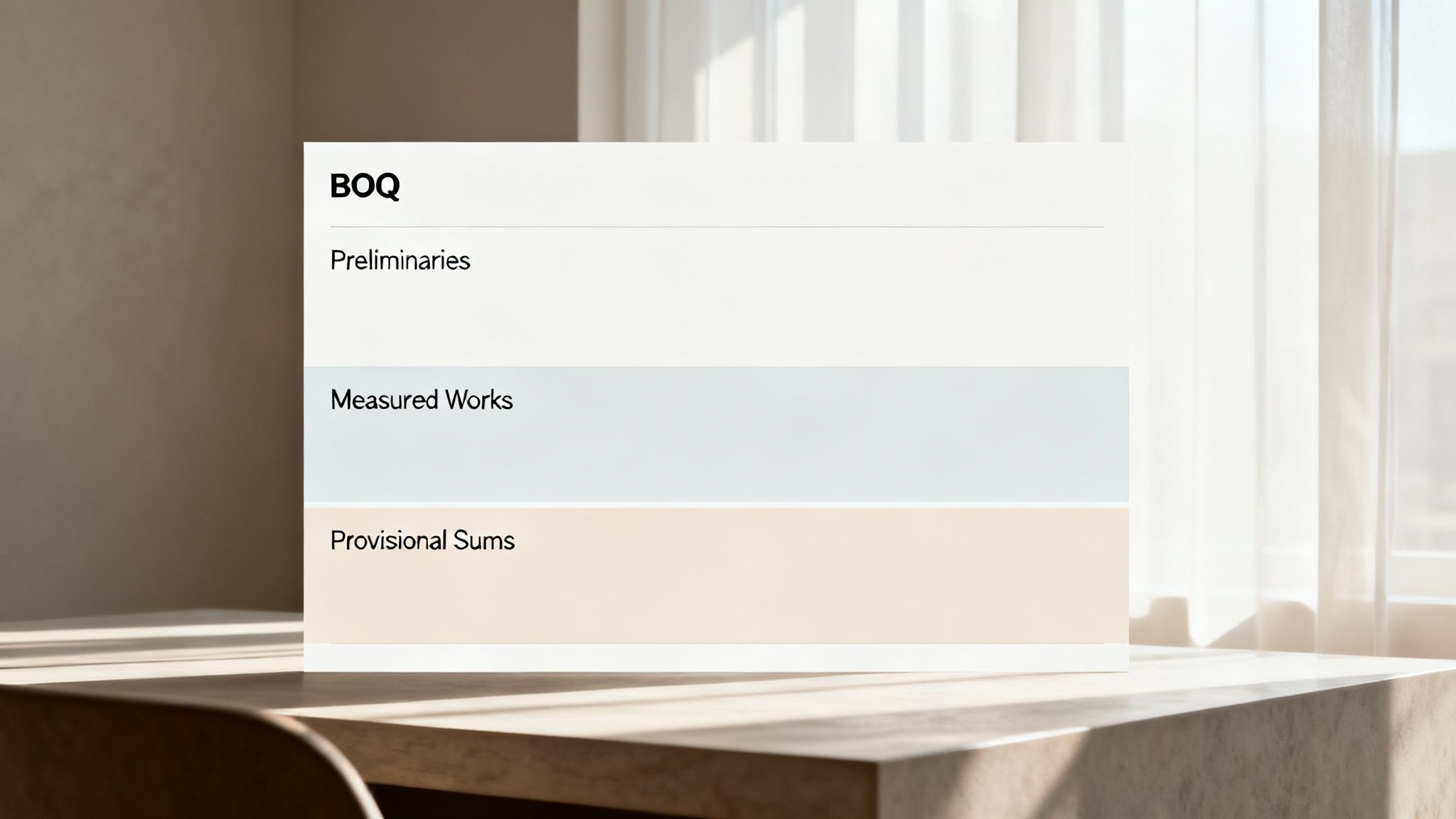
To really get what a BOQ is, you have to look under the hood. A professional Bill of Quantities isn't just one long shopping list; it’s a meticulously structured document where every part has a specific job. Think of it like a book, where each chapter tells a different part of your project's financial story.
This structure makes the entire project easier to digest, breaking down a complex build into clear, priceable pieces. By understanding each component, we can see how a well-made BOQ accounts for everything—from the work you planned for to the things you never saw coming.
Preliminaries: The Project's Foundation
The first major section you'll come across is the Preliminaries. This part doesn't cover physical materials like bricks or steel. Instead, it focuses on the essential indirect costs needed to simply run the project. These are the operational expenses that are absolutely critical for a successful build but are often overlooked by the inexperienced.
For instance, this section includes items such as:
- Site Establishment: Costs for setting up the site office, fencing, and temporary utilities.
- Health and Safety Provisions: Budgets for safety officers, equipment, and compliance measures.
- Insurance and Bonds: Covering necessary project insurances and performance guarantees.
- Project Management Staff: Salaries for the site manager, engineers, and administrative support.
In Dubai's competitive market, getting the Preliminaries priced correctly can be the difference between a profitable project and a significant loss.
A common mistake contractors make is underestimating the Preliminaries. These costs are real and substantial. A professional BOQ ensures they are properly budgeted for, preventing them from eating into your profit margins later on.
Measured Works: The Core of the Build
After the Preliminaries, you get to the largest and most detailed part of the document: the Measured Works. This is the heart of the BOQ. It’s where every tangible piece of the building is listed, described, and quantified. The whole section is organized logically, usually by trade or construction sequence, making it easy to follow the build process from the ground up.
You’ll see sections for things like:
- Foundations and Substructure
- Structural Frame (e.g., concrete, steel)
- Finishes (e.g., plastering, tiling, painting)
- MEP (Mechanical, Electrical, and Plumbing)
Each item is described with precision, ensuring contractors price exactly what the design intends. This level of detail is fundamental to keeping the project's scope in check and avoiding arguments down the line.
Accounting for the Unknown
Finally, a truly solid BOQ includes sections to handle uncertainty—a crucial part of effective risk management in construction projects. Provisional Sums are put in as placeholders for work that is needed but can't be fully detailed yet, like custom joinery or other specialist installations.
On top of that, Dayworks provide a schedule of pre-agreed rates for labor, materials, and equipment. This allows unforeseen tasks that fall outside the main scope to be priced fairly and transparently, without getting stuck in lengthy negotiations.
From Drawings to Bids: The BOQ Creation Process
So, how does a Bill of Quantities come to life? It’s a meticulous process that transforms design blueprints into a document that contractors can actually put a price on. It all starts with a specialist known as a Quantity Surveyor (QS), who essentially acts as the project’s financial architect. Their job is to systematically translate every single line on the architectural and engineering drawings into a quantified, itemized list.
This first critical step is called the ‘taking-off’ process. The QS methodically measures every component of the build—from the cubic meters of concrete needed for the foundation to the exact number of electrical outlets in each room. This isn't just simple counting; it's a deep and detailed interpretation of the design to make sure absolutely nothing gets missed.
Today, the creation and management of BOQs are often supported by specialized construction management software, which helps organize this incredibly complex task.
This infographic shows a quantity surveyor taking off measurements from drawings, a foundational step in creating an accurate BOQ.
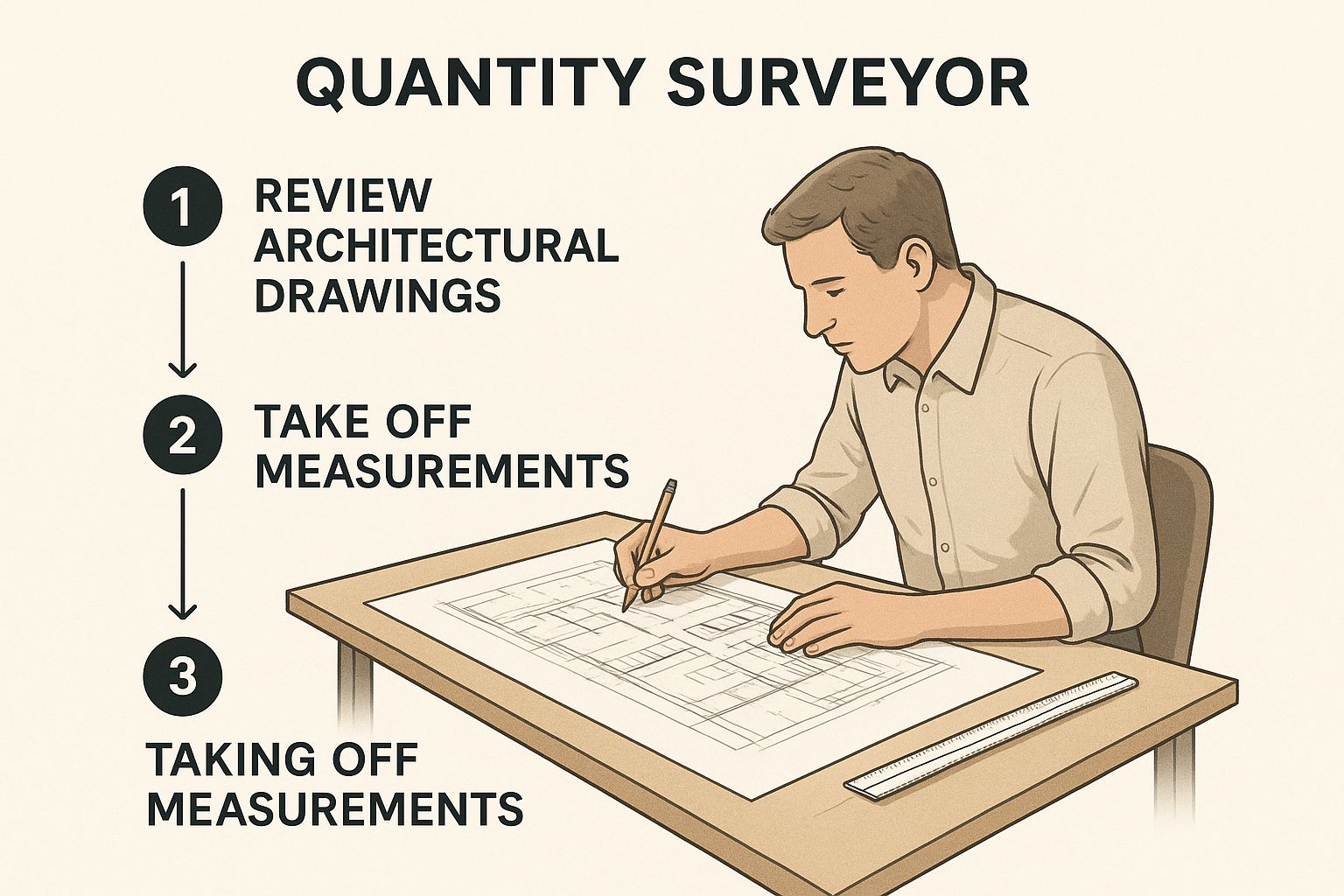
As you can see, it highlights the precision and attention to detail required to turn visual designs into quantifiable data, which is the very essence of the BOQ creation process.
The Contractor's Role: Pricing for Success
Once the draft BOQ has been assembled, double-checked for accuracy, and finalized, it's handed over to contractors as part of the tender package. For contractors in Dubai, this is where the real work of bidding begins. Pricing a BOQ isn't just about crunching numbers; it requires a deep understanding of the local market.
Contractors must apply accurate rates for materials and labor that are specific to the UAE. This means accounting for local supply chain costs, current wage trends, and the price of renting equipment. On top of these direct costs, they need to strategically add their overheads and a realistic profit margin to submit a bid that is both competitive and sustainable.
A common mistake contractors make is applying generic rates without thinking about the specific project conditions. Things like site accessibility in busy parts of Dubai, storage limitations, and local authority regulations can all have a huge impact on costs and must be factored into the pricing.
The Importance of Precision in the Dubai Market
In the UAE's fast-paced construction industry, getting this entire process right is absolutely critical. A precisely prepared BOQ is directly linked to reducing financial risks and avoiding delays, especially in the GCC where fixed-price contracts are the norm.
In fact, studies have shown that projects in the UAE and Saudi Arabia without properly detailed BOQs see up to 30% more claims, which really highlights their critical role in keeping a project's finances predictable.
At Freeline Engineering Consultants, we bridge the gap between design and tender with unmatched precision. Our quantity surveyors have deep-rooted knowledge of the Dubai market, ensuring every BOQ we produce is accurate, comprehensive, and ready for competitive bidding. We provide the clarity contractors need to price with confidence and clients need to achieve true market value.
Choosing the Right BOQ Partner in Dubai
An accurate Bill of Quantities is the foundation of your project's financial success, and that bedrock is laid by the expert you choose to create it. Picking the right quantity surveying firm in Dubai isn’t just another box to tick; it’s a strategic move that directly shapes your budget, timeline, and exposure to risk. The right partner turns a BOQ from a simple list into a powerful tool for cost control and dispute avoidance.
The difference between a merely adequate BOQ and an exceptional one almost always comes down to deep local knowledge. Dubai’s construction scene has its own unique rhythm, governed by specific municipal rules, fluctuating material costs, and a dynamic labor market. A firm without boots-on-the-ground experience simply can't produce a document that reflects these real-world conditions.
What Sets a Top-Tier Firm Apart
A premier quantity surveying partner in Dubai brings more than just technical measurement skills to the table. They offer a real strategic advantage, one that’s rooted in a genuine understanding of the local landscape. Their expertise ensures every single item is not only quantified correctly but also priced in line with current market realities, preventing nasty surprises down the line.
This local insight is absolutely critical for:
- Navigating Regulations: Understanding the nuances of approvals from authorities like Dubai Municipality is essential for a smooth project flow.
- Accurate Costing: Having up-to-date knowledge of local supplier rates and labor costs ensures the BOQ is a reliable financial forecast.
- Proactive Problem-Solving: An experienced local team can anticipate potential site-specific challenges and account for them within the BOQ structure.
Freeline Engineering Consultants lives and breathes this specialized expertise. Our firm was established right here in Dubai back in 1998, giving us decades of first-hand experience in the city’s one-of-a-kind construction sector. We don’t just understand the rules; we’ve navigated them successfully for hundreds of clients.
For projects to succeed financially in Dubai, the BOQ must be more than just accurate—it must be defensible. It needs to be built on a foundation of local market intelligence and meticulous attention to detail that can stand up to scrutiny from contractors and stakeholders alike.
Our Specialized Focus on Mid-Rise Projects
At Freeline, we’ve honed our expertise on a specific and vital segment of Dubai’s built environment: projects up to G+12. This sharp focus on mid-rise residential, commercial, and industrial buildings allows us to offer an unparalleled level of precision. We understand the specific construction methods, material needs, and cost structures for these projects inside and out.
Our meticulous approach ensures every BOQ we produce is a tool for clarity, not confusion. We don't just create documents; we build the financial confidence you need to get your project off the ground successfully. As a leading consultant engineering office in Dubai, we integrate quantity surveying seamlessly with our architectural and engineering services to deliver holistic project oversight.
We firmly believe a great BOQ is the first step toward a profitable and predictable construction journey. It provides the financial roadmap that protects your bottom line from start to finish.
If you are ready to lay the groundwork for a successful project with a BOQ that is precise, reliable, and built on decades of local Dubai experience, we are here to help.
Contact us today for a consultation and discover how our expert quantity surveying services can bring financial clarity and confidence to your next project.
Common Questions About Construction BOQs
When you're dealing with a Bill of Quantities, especially in a market as dynamic as Dubai's, a few questions always pop up. Getting these details right from the start is what keeps a project running like clockwork and protects your budget.
Let’s clear up some of the most common queries we hear from clients.
BOQ vs Estimate: What Is the Difference?
This is a big one, and it's easy to get them mixed up, but the difference is critical.
Think of an estimate as a ballpark figure. It’s an early-stage cost approximation that gives you a rough idea of what the project might cost. It's useful for initial budgeting but doesn't have the nitty-gritty detail needed for a formal contract.
A BOQ, on the other hand, is the real deal. It’s a highly detailed, itemized list of every single material, bit of labor, and specific task required to complete the job. This document is what contractors use during the tendering process, ensuring everyone is pricing the exact same scope of work. It creates a true "apples-to-apples" comparison and almost always becomes a binding part of the final construction contract.
Who Prepares the BOQ?
Preparing a proper Bill of Quantities is a specialist's job. This task typically falls to a professional Quantity Surveyor (QS) or a dedicated cost consultant. They are usually brought on board by the client directly or through the project’s architect.
Their job is to meticulously pour over all the architectural and engineering drawings and translate that complex information into a structured, quantified list. It takes deep technical know-how and, particularly in Dubai, a sharp understanding of local building practices and measurement standards to get it right.
Can BOQ Quantities Change During a Project?
Absolutely. It’s very common for quantities to shift as a project evolves. How this is handled really depends on the type of contract you have in place.
- Re-measurable Contracts: With this popular contract type, the quantities in the initial BOQ are treated as provisional. The final payment is then calculated by re-measuring the actual work done on-site.
- Lump-Sum Contracts: In this case, the contractor agrees to do all the work detailed in the BOQ for one fixed price. If the scope changes—which it often does—the adjustments are managed through formal variation orders. These orders add or subtract costs from the total based on rates agreed upon from the start.
How Does a BOQ Help Manage Variations?
A well-prepared BOQ is your best friend when it comes to managing variations. Because it contains a detailed schedule of rates for every single item (like the cost per square meter for tiling or per cubic meter of concrete), it gives everyone a pre-agreed pricing guide.
So, when a change is needed, you simply use those established rates to calculate the cost of the new work. This completely removes any guesswork or potential for disputes over pricing. It keeps the process transparent and ensures any adjustments to the final bill are fair and easy for everyone to verify.
At Freeline Engineering Consultants, we provide the clarity you need to navigate every aspect of your construction project. With decades of experience in Dubai, we create precise, reliable BOQs that protect your budget and prevent disputes.
Ready to build on a foundation of financial certainty? Get in touch with us today to discuss your project.