
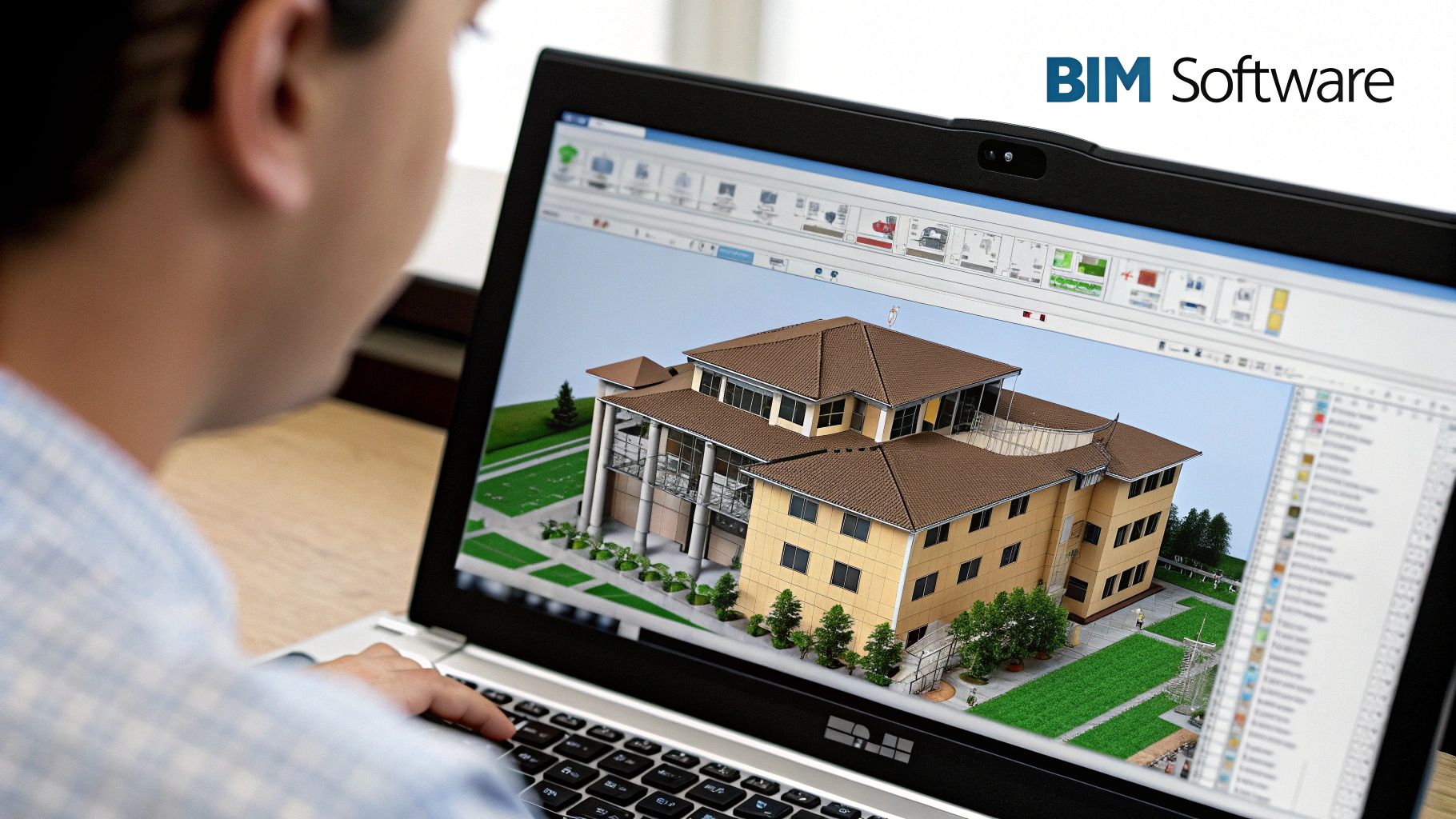
Forget the acronym for a moment. Building Information Modeling (BIM) isn't just another piece of 3D software; it's a completely different way of thinking about how we plan, design, and build in a dynamic city like Dubai.
Imagine a traditional blueprint. It’s a flat, static map. A BIM model, on the other hand, is a dynamic, data-rich digital globe you can spin, explore, and ask questions of—a crucial advantage for the ambitious projects that define the Dubai skyline.
What Is Building Information Modeling, Really?
At its core, Building Information Modeling (BIM) is an intelligent, 3D model-based process. It gives everyone involved in a project—from architects and engineers to construction professionals—the insights they need to manage buildings and infrastructure more effectively.
It creates a single source of truth, allowing every stakeholder to collaborate on one unified model. This is absolutely essential for catching potential conflicts and refining designs in the virtual world, which saves a huge amount of time and money in the real one—a non-negotiable for Dubai's fast-paced, high-stakes construction industry.
Think of it as building an entire skyscraper or luxury villa on a computer first. That’s the power BIM delivers. Every single beam, pipe, window, and door exists not just as a line on a screen, but as an intelligent object packed with data—its dimensions, material, cost, and even its maintenance schedule.
From Flat Drawings to Digital Twins
For decades, the construction industry ran on 2D drawings. They worked, but these flat plans often created communication gaps between architects, structural engineers, and MEP (Mechanical, Electrical, and Plumbing) specialists. A change made on one drawing might not be reflected on another, leading to expensive on-site clashes and rework—a common headache in Dubai's fast-paced building environment.
BIM solves this by creating a centralised digital twin of the physical building. When an architect moves a wall in the 3D model, that change is instantly updated across every single view and document. The structural engineer immediately sees the impact, the MEP engineer can check ductwork placement, and the quantity surveyor gets a revised material list.
This shift from static documents to a live, interconnected model is a game-changer. It encourages proactive problem-solving instead of just reacting to fixes on-site. The benefits are crystal clear, especially when you consider the complex and ambitious designs of modern architecture in Dubai, where precision is everything.
To put it simply, here’s how the old way stacks up against the new.
BIM vs. Traditional Blueprints: A Quick Comparison
| Attribute | Traditional 2D Blueprints | Building Information Modeling (BIM) |
|---|---|---|
| Representation | 2D lines and symbols | 3D models with intelligent objects |
| Data | Limited, static information | Rich, dynamic data (cost, materials, etc.) |
| Collaboration | Siloed; difficult to coordinate | Centralised; all teams work on one model |
| Clash Detection | Manual; often missed until construction | Automated; conflicts found early |
| Changes | Manual updates on multiple drawings | Automatic updates across the entire model |
| Lifecycle View | Focuses on design and construction | Manages data from concept to demolition |
The table makes it clear: BIM offers a far more integrated and intelligent approach, moving beyond simple drawings to create a comprehensive digital asset.
It's a Process, Not Just a Product
It’s so important to understand that BIM is a collaborative process, not just a piece of software. While tools like Revit, Navisworks, and Tekla are the engines that run BIM, the real value comes from the workflows it supports. A BIM project's success hinges on how well teams share and manage information.
At its heart, Building Information Modeling is about improving information flow. Reliable and accurate information is the lifeblood of any project, and BIM provides the framework to manage that data effectively from concept through to demolition.
As a leading engineering consultancy in Dubai for nearly three decades, we’ve seen firsthand how a well-executed BIM strategy completely changes project outcomes. It aligns perfectly with what our clients—be they real estate developers, industrial facility managers, or homeowners—are looking for. By integrating design and construction data from day one, we provide a clearer, more predictable path to success. The result isn't just a better building, but a better building experience for everyone involved.
Exploring The Dimensions of BIM
The real magic of Building Information Modeling isn't just in the 3D model you can see; it's in the layers of data tucked inside it. We call these 'dimensions', and they're what elevate a simple digital shape into a powerful, intelligent asset for any construction project.
Most people get the visual part—the 3D model. It’s the foundation, showing us the "what" and "where" of a building. But in a fast-paced market like Dubai, answering "when" and for "how much" right from the start is absolutely critical. This is where the higher dimensions of BIM come into play, taking us far beyond simple visuals and into the realm of smart simulation and forecasting.
To see just how far building design has come, this chart maps out the journey from basic drawings to the data-packed models we rely on today.
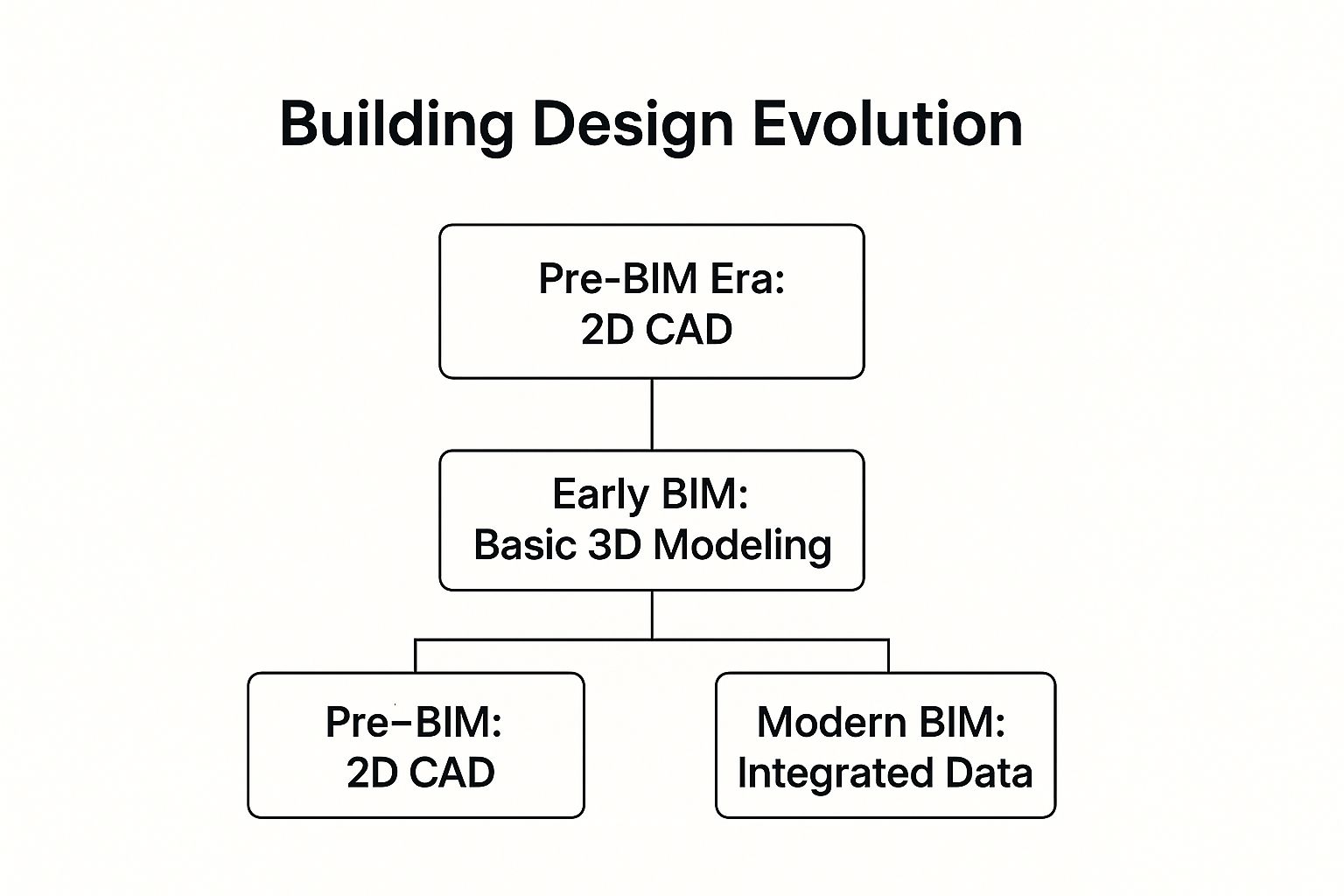
It’s clear that modern BIM isn't about making a pretty 3D object. It's about weaving layers of practical, actionable information directly into that object.
From 3D to 7D: A Practical Breakdown
Each dimension adds a unique, powerful capability to the model. Getting to grips with these layers is the key to understanding why BIM is a superior process for modern construction here in the UAE.
3D (The Model): This is the one everyone knows – the three-dimensional geometric model. It provides the visual and spatial foundation for everything else, letting teams see and walk through the building before a single shovel hits the ground.
4D (The Schedule): This is where we bring time into the picture. The 4D dimension links the construction schedule directly to the 3D model. We can create a visual simulation showing exactly how the project will be built, piece by piece, over time.
5D (The Cost): Now for the money. With 5D, we attach detailed cost data to every component in the model. As the design changes, the budget updates automatically. This gives stakeholders real-time financial insight and makes cost forecasting incredibly accurate.
This multi-layered approach gives us an amazing level of control. Think about building a new residential tower in Dubai Marina. Using 4D BIM, we can simulate the entire construction sequence to optimise crew movements, spot potential logistical jams, and make sure materials arrive exactly when they’re needed. No more costly delays.
At Freeline Engineering Consultants, we think of these dimensions as layers of certainty. Each one adds a new level of predictability, helping our clients in Dubai manage risks and make smarter decisions long before breaking ground.
Unlocking Lifecycle Value with 6D and 7D
The benefits of BIM don't stop when construction is finished. The higher dimensions are all about the building's entire life, delivering value for decades. This is a huge deal for our commercial and industrial clients in Dubai who manage large, complex facilities.
6D (Sustainability)
The sixth dimension is all about green building and operational efficiency. It integrates sustainability analysis right into the design. We can test a building's energy performance, analyse its exposure to sunlight, and check its thermal efficiency before it’s even built. For a project like a new school in Dubai, this means we can tweak the design to slash long-term running costs and create a much more comfortable learning environment.
7D (Facility Management)
The seventh dimension is where the model truly comes alive for building operators. It’s all about embedding operations and maintenance data directly into the model’s components. Imagine a facilities manager at a new JAFZA warehouse. Instead of digging through filing cabinets, they can just click on an HVAC unit in the model to instantly see its serial number, maintenance schedule, and warranty details.
This transforms the BIM model into a living "digital manual" for the building, making maintenance and repairs a breeze and ensuring the facility runs at peak efficiency for its entire life.
By weaving these dimensions together, we shift from a static blueprint to a dynamic, living digital twin of the asset. It’s this complete picture that empowers our team at Freeline Engineering Consultants to deliver projects in Dubai with unmatched control and foresight. We don’t just design buildings; we build a detailed digital strategy for success, from the first sketch all the way to long-term operation.
Ready to see how these dimensions can be applied to your project? Contact our expert team today and let’s build with intelligence.
Why BIM Is a Game-Changer for Dubai Construction
Dubai's ambition is vertical, spelled out in a skyline of iconic structures that push the boundaries of engineering. But building these marvels comes with immense challenges. In such a high-stakes environment, old-school construction methods—often plagued by budget overruns, project delays, and coordination headaches—just don't cut it anymore.
This is where Building Information Modeling (BIM) becomes more than just an advantage; it’s a strategic necessity. With government mandates in both Dubai and Abu Dhabi driving its adoption, BIM is now the definitive answer to the historical issues that can stall even the most prestigious projects. It provides a digital framework for control and predictability in a market defined by speed and complexity.
Mitigating Risk in a Fast-Paced Market
The construction industry across the Middle East has long grappled with major inefficiencies. Complex projects, by their very nature, can create a gap between what a client expects and what a contractor delivers, often leading to lost revenue and sluggish productivity.
Building Information Modeling is now widely seen as the solution. By building a project digitally before a single shovel hits the ground, BIM helps us master time management, slash risks, and boost safety on site. To dive deeper, you can review some findings on how BIM addresses regional construction challenges at etasr.com.
At Freeline Engineering Consultants, we use BIM to turn these risks into opportunities for excellence.
- Proactive Clash Detection: Imagine discovering that HVAC ducts conflict with structural beams during installation. It's a costly and time-consuming fix. Instead, we find and resolve these clashes in the digital model long before they become real-world problems. This one feature can save millions on a large project.
- Accurate Cost Forecasting (5D BIM): By linking our model to real-time cost data, we give clients a transparent and predictable budget. Any design change instantly updates the total cost, which means no more nasty financial surprises down the line.
- Optimised Scheduling (4D BIM): We can simulate the entire construction sequence from start to finish. This helps us optimise logistics, material deliveries, and workforce allocation, ensuring the project stays on its critical path—a vital factor for success in Dubai.
Streamlining Stakeholder Collaboration
A single Dubai skyscraper can involve dozens of consultants, contractors, and suppliers. Trying to keep everyone aligned with stacks of 2D drawings is a recipe for miscommunication. BIM changes that by creating a unified platform where every stakeholder—from the architect in our office to the fabricator on the factory floor—works from the exact same information.
For us, BIM is the ultimate communication tool. It creates a 'single source of truth' that ensures every decision is based on current, accurate data, fostering a truly collaborative environment where problems are solved before they ever reach the construction site.
This collaborative approach is fundamental to effective project management in the construction industry. You can learn more about how this integrated management improves outcomes by reading our guide on effective project management in the construction industry. By getting all parties on the same page from day one, we reduce disputes and speed up decision-making, which is crucial for meeting tight deadlines.
The Freeline Engineering Consultants Advantage
For nearly three decades in Dubai, we've witnessed firsthand how technology can transform project delivery. We don’t just offer BIM services; we provide the strategic insight that makes the technology work for your specific goals. Our deep understanding of local regulations from Dubai Municipality and other authorities means your project is designed for compliance from the very beginning.
Choosing Freeline Engineering Consultants means selecting a partner who uses BIM not just as a design tool, but as a comprehensive strategy for delivering certainty. We translate our digital expertise into your real-world success through reduced risk, predictable costs, and superior build quality. In a city that demands nothing less than the best, our BIM-driven process gives you the confidence to build bold.
Ready to bring this level of predictability and excellence to your next project? Contact us to see how our BIM expertise can make the difference.
How BIM Delivers Real-World Results in Dubai
The true value of Building Information Modeling isn't in theory; it's in the tangible, real-world results you can see and measure. When we move beyond the concepts, we see just how powerful this intelligent process is across Dubai's diverse construction landscape. From towering skyscrapers to essential community facilities, BIM is actively solving problems and creating value every single day.
Picture a new commercial tower going up in Business Bay. During the digital design phase, the BIM model flags a critical conflict: a primary HVAC duct is on a direct collision course with a major structural beam. In the past, an error like this would probably go unnoticed until construction was well underway, leading to on-site fabrication changes, costly delays, and a lot of finger-pointing.
With BIM, this clash is identified and resolved within the model in minutes. This simple, proactive step can save a developer millions of dirhams in potential rework and keeps the entire project on schedule. That’s the practical power of solving problems before they happen.
Sector-Specific Success Stories
The benefits of BIM aren’t just for one type of project. Its flexibility means it can be applied with great effect across residential, industrial, and educational sectors, each with its own unique set of challenges and goals.
For a residential developer planning a new apartment complex in JVC, the main goal is often maximising the saleable area while delivering high-quality living spaces. Using BIM, our teams can quickly test different layouts, optimising floor plans and MEP (Mechanical, Electrical, and Plumbing) systems to hit that perfect balance. We make sure every square metre serves a purpose, which means a more profitable and desirable final product for our client. The detailed insights into MEP engineering in Dubai that BIM provides are absolutely critical for this.
Now, think about an industrial project, like a new manufacturing plant in Dubai Industrial City. The challenges here are completely different, focusing on complex logistics, heavy equipment placement, and operational efficiency. BIM allows us to model the entire workflow—from the delivery of raw materials to the movement of machinery—before a single foundation is poured. We can run simulations to spot bottlenecks and design a facility that's built for maximum productivity from day one.
Designing Future-Proof Community Assets
BIM's application also extends to vital community infrastructure, like schools and universities. When designing a new campus, the focus is on creating a sustainable, safe, and inspiring learning environment that will serve the community for decades to come.
Using BIM, we can perform detailed energy analysis (6D BIM) to optimise the building’s orientation, shading, and material choices specifically for Dubai’s climate. This leads to significantly lower operational costs over the building's lifespan. Later, that same model becomes an invaluable asset for facility management (7D BIM), helping the school’s maintenance team operate the campus efficiently for years.
At Freeline Engineering Consultants, we don’t just build models; we build certainty. We translate the data within BIM into actionable intelligence that protects our clients' investments and ensures their vision is realised with precision and predictability.
Understanding BIM's Market Growth and Future
Building Information Modelling isn't just a fleeting trend; it’s the new bedrock of modern construction, and its momentum is undeniable. Here in the Middle East, the economic engine driving BIM adoption is particularly powerful, and the data on its market growth tells a compelling story. This isn't just a slow evolution—it's a fundamental shift in how the region's most ambitious projects come to life.
For any firm operating in Dubai, getting to grips with this trajectory is crucial for staying competitive. The numbers paint a very clear picture: the industry is rapidly standardising around BIM, making its adoption less of an option and more of a necessity for any company that wants to lead the pack.
The Economic Case for BIM Adoption
The financial argument for switching to BIM is impossible to ignore. The Building Information Modelling market across the Middle East & Africa is on track for explosive growth, with forecasts predicting a market size of roughly $7.7 billion by 2025. This surge is powered by a compound annual growth rate (CAGR) of about 22%. You can dive deeper into these BIM market projections on marketreportanalytics.com.
This isn’t just an abstract number. It’s a direct result of increased BIM adoption across every corner of the construction industry, from residential towers and commercial centres to massive infrastructure projects. For any construction or engineering firm in Dubai, these figures point to one clear reality—the future is being built with BIM.
Choosing to ignore this shift is choosing to be left behind. This is about more than just keeping up; it’s about positioning your company to successfully bid for, win, and deliver on the region's growing pipeline of complex, high-value projects.
Why Freeline Engineering Consultants Is Your Best BIM Partner
The market data makes it clear that knowing what is building information modeling is one thing, but making it work for your project is what really counts. This is where our deep, on-the-ground experience in the Dubai market truly makes a difference. We don’t just provide BIM services; we deliver strategic implementation that’s fine-tuned for the specific demands of this region.
Our approach rests on three core pillars that establish us as the leading choice for BIM in Dubai:
- Local Regulatory Mastery: With nearly 30 years in Dubai, we have an expert-level grasp of Dubai Municipality regulations and other local authority requirements. This isn't just about ticking boxes; it's about intelligent design that anticipates and solves compliance issues, ensuring a smooth approvals process.
- Proven Process Integration: We’ve spent decades refining our workflows to integrate BIM seamlessly, turning its potential into measurable results like less rework, predictable project timelines, and enhanced build quality. We make the technology serve the project, not the other way around.
- Client-Centric Strategy: We always start with your specific project goals. Whether it’s a luxury villa, an industrial facility, or a residential tower, our focus is to deploy a BIM strategy that delivers maximum value and return on investment for you.
Choosing the right partner is just as important as choosing the right technology. At Freeline Engineering Consultants, we combine advanced BIM capabilities with extensive on-the-ground knowledge of Dubai to safeguard your investment and bring your vision to life with precision.
The future of construction in Dubai is intelligent, data-driven, and built on collaboration. By partnering with us, you aren't just adopting a new technology; you're securing a competitive edge built on proven expertise and a genuine commitment to excellence.
Let's discuss how our expert BIM services can position your next project for success. Contact us today for a detailed consultation.
Choosing Your Expert BIM Partner in Dubai
Taking your project into the digital realm is about more than just buying software. It’s about finding a partner who truly gets it—someone who understands both the technology and the unique, complex landscape of building in Dubai. This is where we come in. We don't just "do" BIM; we provide the confidence that comes from years of proven, on-the-ground expertise.
Learning what building information modeling is all about leads you to this crucial decision: picking the right team to make it all happen. In a market as dynamic and demanding as Dubai, a generic, one-size-fits-all approach just won’t cut it.
Local Expertise Meets Technical Excellence
A successful BIM strategy lives or dies by its understanding of local standards. Our team has an intimate, up-to-the-minute knowledge of Dubai Municipality regulations and other authority requirements. This means your project is designed for compliance from the very first sketch, which is absolutely critical for avoiding frustrating—and expensive—delays and revisions during the approvals process.
We turn this specialised knowledge into real-world benefits for your project:
- Reduced Risks: By catching potential regulatory conflicts and on-site clashes inside the digital model, we solve problems long before they can throw your timeline and budget off track.
- Predictable Costs: Our 5D BIM integration gives you a live, transparent look at project expenses, putting you in the driver's seat for all financial decisions.
- Superior Quality: A fully coordinated, clash-free model ensures that what you see in the design is exactly what gets built. The result is a higher-quality asset with far fewer defects.
This laser focus on local compliance and technical accuracy is what separates a premier engineering office in Dubai from the rest. It's about building on a foundation of certainty from day one.
A Client-Centric Strategy for Maximum Impact
Your vision is our blueprint. We don't believe in cookie-cutter solutions. Instead, we embrace a client-centric model, tailoring our BIM workflows to hit your specific project goals—whether you’re building a luxury villa, a sprawling industrial facility, or a multi-storey residential complex. Think of us as your expert guide, here to help you unlock the full power of BIM.
This customised approach is more important than ever as excitement around BIM continues to build. Recent industry surveys show that a massive 97.6% of respondents in the Middle East and Africa are expecting revenue growth driven by digital tech. With the building and civil contracting sectors feeling particularly confident—nearly 39% expect gains exceeding 15%—having a skilled partner is essential to ride this wave of opportunity. You can explore more of this data in this construction industry outlook report.
At Freeline Engineering Consultants, we blend nearly three decades of hands-on Dubai experience with sophisticated BIM capabilities. Our promise is simple: to transform your vision into a precisely engineered reality, protecting your investment and guaranteeing excellence every step of the way.
Your Next Step Towards a Smarter Project
Choosing a BIM partner is one of the most significant decisions you'll make. It’s not just about finding someone who knows the software; it’s about finding a team that acts as a true extension of your own—a team that is genuinely invested in seeing you succeed.
We're ready to show you how our approach can elevate your next project, delivering the clarity, control, and quality that only a truly integrated BIM process can offer.
Contact our team of experts today. Let's start a conversation about how we can build your vision with confidence and precision.
Common Questions About Building Information Modeling
As you start looking into Building Information Modeling and what it can do for your projects, a few common questions always seem to pop up. Getting clear, straightforward answers is the first step to making a good decision and starting your project on solid ground. We’ve gathered some of the most frequent questions we hear from clients right here in Dubai to help clear things up.
Is BIM Only for Large Construction Companies in Dubai?
Not at all. While BIM is absolutely essential for managing the sheer complexity of a major high-rise, its benefits scale beautifully to projects of any size. We see smaller firms and even private villa projects use BIM to get a serious competitive edge. It helps them boost efficiency, slash errors, and deliver a much higher quality result with far more certainty on the final cost.
The trick is having a smart implementation strategy that fits the project. The right expert partner can help you get the most out of your investment, whether you’re building a single luxury home or a sprawling commercial development.
What Is the Difference Between 3D CAD and BIM?
At first glance, they might look similar, but they are fundamentally worlds apart. Think of a 3D CAD model as a sophisticated digital drawing board—it’s used to create geometric shapes and lines. A BIM model, on the other hand, is built with intelligent, data-rich objects.
A wall in a BIM model isn't just a shape; it's a smart component that "knows" everything about itself—its materials, its cost, its fire rating, and its structural properties. It’s the "I" in BIM—the Information—that makes all the difference. This allows for deep analysis and collaboration that simple CAD just can't touch.
How Much Does It Cost to Implement BIM?
The cost of implementing BIM really depends on the project's scope, its complexity, and the Level of Development (LOD) required. There's an initial investment in software and training, of course, but it’s so important to see BIM as an investment that pays for itself many times over.
The savings you get from catching clashes before they happen on-site, dramatically cutting down on rework, and optimising project schedules consistently deliver a powerful return. In a market as competitive as Dubai’s, the cost of not using BIM is often much, much greater.
Do I Need an Expert to Implement BIM?
While you can certainly learn some basic BIM functions in-house, unlocking its full potential—especially for the kinds of complex projects we see in Dubai—requires real expertise. A specialised partner makes sure the model is set up correctly from day one, complies with all local regulations like Dubai Municipality standards, and follows a strategy designed to deliver the maximum return.
An expert's guidance is also vital for selecting the right consultant and avoiding the kinds of expensive implementation mistakes that can derail a project.
At Freeline Engineering Consultants, we don't just provide BIM services; we offer a strategic partnership built on nearly three decades of Dubai-specific experience. We translate complex data into clear, actionable insights that protect your investment and ensure your vision is realised with precision. If you’re ready to move beyond the questions and start seeing results, we are here to guide you.