
Let's start with a clear answer: MEP stands for Mechanical, Electrical, and Plumbing. These are the vital systems that make a building in Dubai livable and functional.
Think of MEP as a building's central nervous system, circulatory system, and respiratory system all rolled into one. It’s the complex web of wires, pipes, and ducts hidden behind the walls that provides everything from power and water to clean air and comfort.
The Hidden Heartbeat of Your Building
Every impressive structure you see in Dubai, whether it’s a sleek residential villa or a buzzing commercial center, relies on a complex network operating silently behind the scenes. This is the world of MEP engineering, the discipline that turns an empty shell into a safe, comfortable, and functional space for people.
Without these integrated systems, a building is just a static structure. It's MEP that brings it to life.
In a demanding climate like Dubai's, the 'M' for Mechanical is especially critical, focusing on air conditioning and ventilation to keep indoor temperatures comfortable. The 'E' for Electrical powers every light, socket, and safety system, while the 'P' for Plumbing ensures a steady supply of clean water and efficient waste removal. Together, they are the lifeblood of modern construction.
To break it down even further, here's a quick look at what each discipline covers.
The Three Pillars of MEP: A Quick Overview
| Discipline | Key Systems | Primary Purpose in a Building |
|---|---|---|
| Mechanical | Heating, Ventilation, and Air Conditioning (HVAC), Exhaust Systems, Building Automation | To regulate temperature, ensure air quality, and maintain a comfortable indoor environment. |
| Electrical | Power Distribution, Lighting, Fire Alarms, Security Systems, Data/Communication | To supply safe and reliable power for all building functions, from lighting to life-saving systems. |
| Plumbing | Water Supply (Hot & Cold), Drainage, Sewage Systems, Gas Piping, Stormwater Management | To deliver clean water where it's needed and safely remove all forms of wastewater. |
As you can see, each pillar has a distinct job, but they all have to work together perfectly for a building to function as intended.
Why MEP is a Growing Priority in Dubai
The push for smarter, more efficient buildings has made expert MEP design more important than ever. In the UAE, there is a major drive toward sustainable construction, which directly impacts how these systems are engineered from the ground up.
MEP is not just about functionality; it's about future-proofing assets. A well-designed system reduces operational costs, enhances occupant well-being, and significantly increases a property's long-term value.
This focus on efficiency is clearly reflected in market trends. The Middle East's energy-efficient buildings market, valued at USD 772.8 million, is projected to soar past USD 2.5 billion by 2033. This growth is fueled by government sustainability goals and the rising demand for advanced HVAC and plumbing solutions.
The infographic below shows a cross-section of a modern building, revealing how these essential systems are integrated behind the walls.

As you can see, the artful arrangement of these components is crucial to prevent clashes and ensure every system has the space to function perfectly.
At Freeline Engineering Consultants, we specialize in designing and coordinating these intricate systems for projects up to G+12. Our deep understanding of local Dubai regulations and our commitment to practical, cost-effective solutions ensure your project's essential systems are reliable from day one.
We deliver seamless integration that aligns with your vision and budget, making us the ideal partner for your next development. You can explore our integrated approach to building and engineering on our website.
Mechanical Systems Driving Comfort and Air Quality
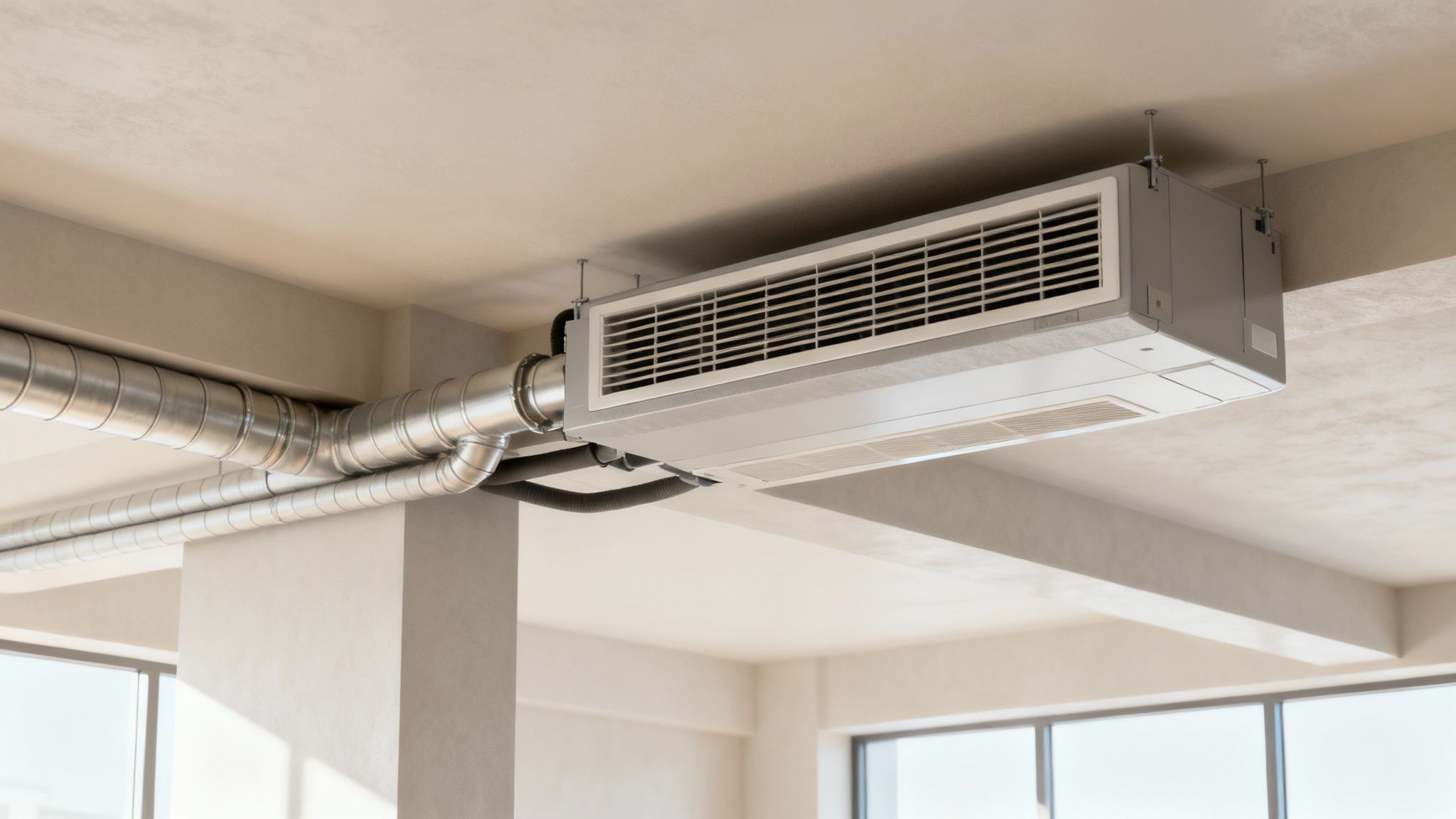
Now, let's pull back the curtain on the 'M' in MEP: the mechanical systems that truly bring a building to life. In a place like Dubai, the conversation almost always kicks off with HVAC (Heating, Ventilation, and Air Conditioning). This is the workhorse, the engine that fights the intense regional climate to create a comfortable, livable indoor space.
But it’s about so much more than just pumping cold air. A great HVAC system is a carefully engineered solution that manages thermal comfort, humidity, and clean air. The end goal is a perfectly balanced atmosphere, whether that's in a family home, a residential apartment building, or a busy corporate office. For a deeper dive into the technology, it's helpful to understand the different commercial HVAC system types available.
Common HVAC Solutions in Dubai
For most residential and commercial projects up to G+12, the choice often comes down to two main systems, each with its own advantages:
- Split Units: You’ve seen these everywhere. Perfect for smaller spaces like villas or individual apartments, they consist of an indoor unit pushing cool air and an outdoor unit that gets rid of the heat. They’re straightforward to install and offer control over a single zone.
- VRF/VRV Systems: Variable Refrigerant Flow (or Volume) systems are the more advanced big brother. One powerful outdoor unit connects to many indoor units, making it ideal for larger buildings. This setup is incredibly energy-efficient and allows different zones to be heated and cooled at the same time.
The right choice always depends on the building's scale, how it will be used, and the project budget. At Freeline Engineering Consultants, our job is to design an HVAC solution that isn't just effective on day one, but is also reliable and cost-efficient for years to come.
Beyond Cooling: Life Safety Mechanical Systems
Mechanical engineering goes far beyond keeping you comfortable. Here in Dubai, life safety is an absolute priority, and a whole host of unseen mechanical systems are working behind the scenes to protect people and meet strict Dubai Civil Defence (DCD) codes.
An effective MEP design doesn't just provide comfort—it provides peace of mind. Critical safety systems like smoke management are non-negotiable components that protect lives and property, forming the backbone of a building's emergency response plan.
These vital, life-saving systems include:
- Smoke Management: If a fire breaks out, these systems are designed to control the flow of smoke, keeping escape routes like stairwells clear and giving emergency crews better visibility. This is often done by pressurizing key areas to keep smoke out.
- Car Park Ventilation: Any enclosed car park needs a powerful ventilation system. Its job is to pull out harmful exhaust fumes like carbon monoxide and, in a fire, to clear thick smoke. Getting this design right is a non-negotiable for DCD approval.
These systems are the unsung heroes of a building's safety plan. To see how these complex systems are integrated, you can learn more about placing mechanical services on the roof in our detailed guide.
Electrical Systems Powering Your Project Safely
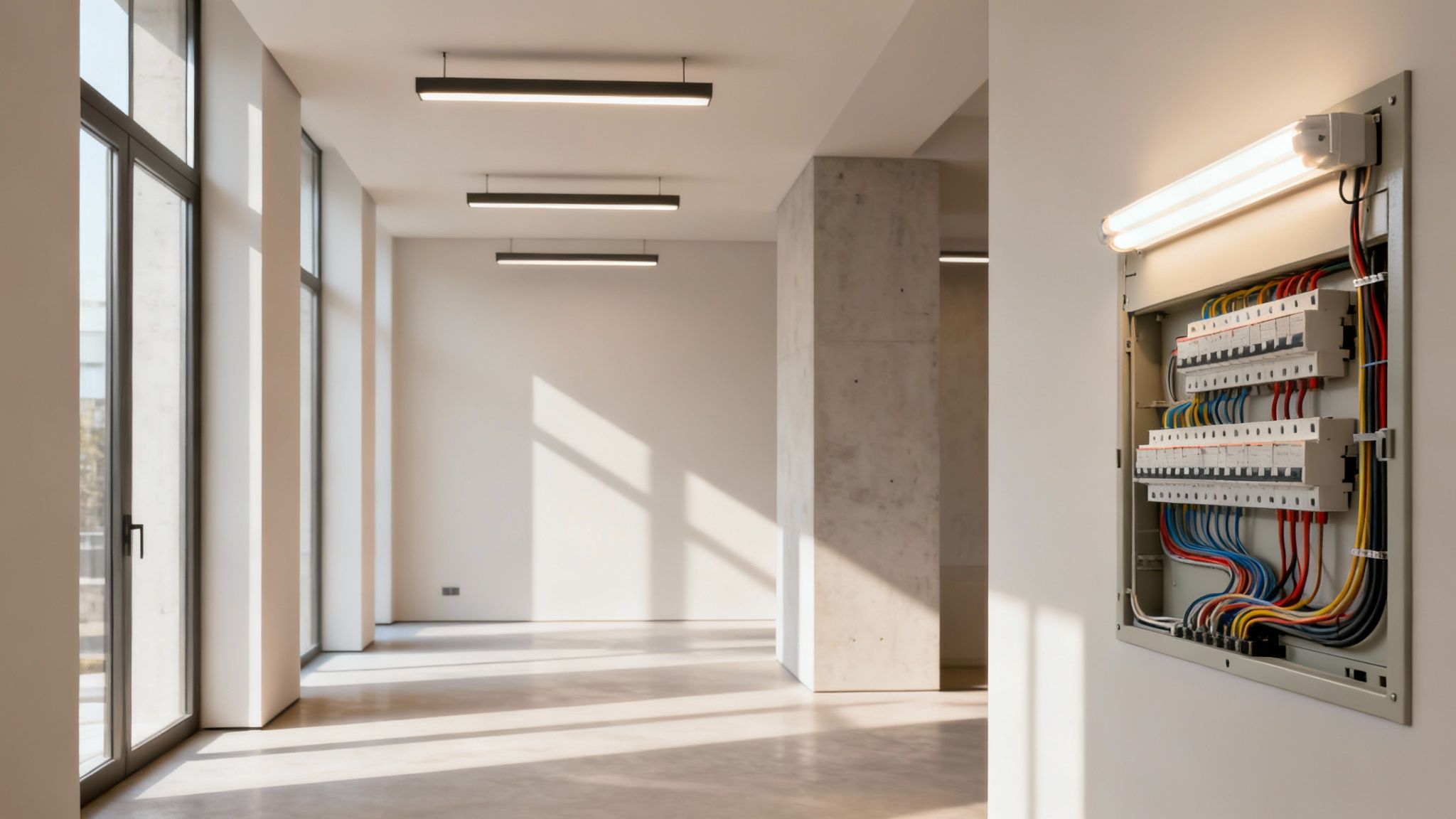
Now we get to the 'E' in MEP—the electrical systems that act as the building's central nervous system. A thoughtfully designed electrical infrastructure is the backbone of any modern project, safely delivering power to every light switch, socket, and critical piece of equipment.
It all starts at the source, connecting to the local grid managed here in Dubai by the Dubai Electricity and Water Authority (DEWA). From that main connection point, power flows into the building, where it needs to be managed carefully.
This isn't as simple as just plugging things in. The high-voltage electricity is first stepped down through transformers, then routed to main distribution boards (MDBs). These MDBs act like hubs, feeding smaller, localized panels that distribute the right amount of power to individual circuits. This careful process prevents overloads and ensures every part of the building gets the correct voltage it needs.
More Than Just Wires and Outlets
A professional electrical plan is far more than a simple map of wires and outlets. It's a fully integrated network built for safety, efficiency, and the demands of modern living. A proper electrical design accounts for every single component that needs power, ensuring reliability and full compliance with Dubai's strict building codes.
Some of the key components of a modern electrical system include:
- Energy-Efficient Lighting: We don't just place lights; we design layouts that create the perfect ambiance while keeping energy use to a minimum. This involves picking the right fixtures and often incorporating smart controls.
- Fire Alarm Systems: A dependable fire detection and alarm system is absolutely non-negotiable. Our designs meet all Dubai Civil Defence (DCD) requirements to keep occupants safe.
- Low-Current Infrastructure: This is the nervous system within the nervous system. It covers everything from CCTV and access control for security to the structured cabling that your data and communication networks rely on.
The real mark of an expert electrical design is its invisibility. When systems work flawlessly and safely day in and day out, it's a direct result of meticulous planning, deep regulatory knowledge, and a commitment to quality from the very beginning.
Why Expert Electrical Design Is Crucial in Dubai
In Dubai, every electrical design must be approved by both DEWA and the DCD. Navigating their specific requirements is a specialized skill. An improperly designed system isn’t just a safety hazard; it’s a guarantee for failed inspections, which can bring a project to a screeching—and expensive—halt.
At Freeline Engineering Consultants, we've spent nearly three decades mastering the local regulations for projects up to G+12. This experience means every electrical plan we develop is not just functional but also fully compliant, paving the way for a smooth and timely approval process. We deliver practical, cost-effective solutions that provide the safe, reliable power your building needs to thrive.
For a partner who understands the intricacies of Dubai's electrical requirements and is committed to delivering excellence, contact Freeline Engineering Consultants today. Let us lay the foundation for a safe, modern, and fully functional space.
Plumbing Systems: The Unseen Network for Health
Now, let's talk about the 'P' in MEP—plumbing. It’s the intricate network of pipes and fixtures responsible for managing a building's entire water cycle. A professional plumbing system is so much more than just taps and drains; it's a fundamental pillar of public health, making sure clean water arrives safely and wastewater is removed hygienically.
Think of a building's plumbing as a story of two connected systems. First, you have the water supply, which delivers clean, pressurized water for everything we do. This involves a carefully planned web of pumps, tanks, and water heaters designed to meet the building's specific demands, whether it's a small villa or a multi-story residential block.
Ensuring Clean Water and Safe Removal
Just as important is the drainage system. This network of pipes is engineered to carry away every drop of wastewater from sinks, showers, and toilets, preventing nasty backups, odors, and contamination. Its design has to be precise to maintain proper flow and ventilation, which is non-negotiable for safeguarding the health of everyone inside.
For total peace of mind when it comes to water quality, many modern buildings implement advanced whole house water filtration systems. This extra step ensures that every single tap delivers pure, filtered water.
Beyond wastewater, an effective plumbing design also has to handle stormwater. In Dubai, a sudden downpour can be incredibly intense. A well-designed stormwater drainage system is absolutely crucial for channeling this water away from the structure, protecting the building's foundation from damage and ensuring its long-term stability.
The Bigger Picture: Energy and Environmental Impact
In the GCC, the MEP sector is on the front lines of addressing the region's high energy consumption. Countries like the UAE are among the highest per capita carbon emitters, partly due to the immense energy needed to power buildings. Efficient MEP systems, especially for water heating and pumping, are key to bringing this number down. This highlights just how urgent the need for sustainable solutions is.
Plumbing is the unseen guardian of a building's health and hygiene. From the clean water you drink to the wastewater it safely removes, every component is designed to protect occupants and preserve the structural integrity of the asset.
At Freeline Engineering Consultants, we design plumbing systems for projects up to G+12 that are both rock-solid reliable and impressively efficient. Our deep expertise in local Dubai regulations ensures every system we design—from water supply to drainage—is fully compliant and built to last. We focus on creating practical, cost-effective solutions that are essential for any modern construction project.
Ready for a plumbing system designed with precision and foresight? Contact Freeline Engineering Consultants to discuss how we can bring our expertise to your next Dubai project, ensuring a healthy and functional environment from the ground up.
Why Seamless MEP Coordination Is Non-Negotiable
Understanding the individual mechanical, electrical, and plumbing systems is one thing. Getting them all to work together harmoniously within the tight confines of a building is a completely different challenge.
This is where MEP coordination moves from being a simple line item to the most critical factor in a project's success or failure. Without it, you're not just planning a building; you're inviting chaos onto your construction site.
Think of it like this: you're trying to fit a building's arteries (the plumbing), its veins (the ductwork), and its entire nervous system (all the electrical wiring) into the same small spaces within the walls and ceilings. What happens when they overlap? You get pipes running into ducts, conduits hitting beams, and access points being blocked off. In the industry, we call these clashes.
Clashes aren't minor hiccups. They are the direct cause of on-site modifications, painful project delays, and budgets that spiral out of control.
The High Cost of Poor Planning
When MEP systems are designed in their own separate silos, conflicts are not just possible—they're guaranteed. A plumbing line might be planned for the exact same spot as a massive air duct, or a cable tray could be routed straight through a structural support beam.
Finding these problems during the construction phase is a nightmare. It forces expensive rework, wastes materials, and throws the entire project schedule off track.
This is precisely why expert MEP coordination isn't a luxury; it's a fundamental necessity. The goal is to catch and resolve every single potential clash on paper (or, more likely, on a screen) long before the first boot hits the ground. Proactive coordination is the single most effective way to save time, money, and a world of future operational headaches.
"The success of a modern construction project is measured not just by its final appearance, but by the unseen harmony of its systems. Seamless MEP coordination is the art of ensuring this harmony from day one, preventing costly conflicts before they ever materialise."
The Freeline Approach to Coordination
At Freeline Engineering Consultants, we don’t just see MEP coordination as a box to tick; we treat it as a foundational step of the entire project. Our process involves creating a single, unified model where every pipe, duct, and wire is meticulously mapped out.
This gives us the complete picture, allowing our team to spot potential conflicts from a mile away and reroute systems efficiently before they become a real-world problem.
Our deep-rooted experience in Dubai's unique construction landscape ensures our coordinated designs are not only clash-free but also practical for installation and simple for future maintenance. The industry's growing focus on MEP integration here in the UAE is part of a wider shift toward building smarter.
For instance, massive infrastructure like district cooling, with about 25% of the world's total capacity located in the Gulf, is essential for managing energy loads in today's complex buildings. You can find more insights on regional infrastructure trends here.
Bringing a specialized firm like ours into the project early is one of the smartest investments you can make. We ensure your building’s vital systems are perfectly integrated, saving you from expensive surprises down the line.
Contact us today to ensure your project benefits from expert MEP coordination.
Choosing the Right MEP Partner for Your Dubai Project
Picking the right MEP engineering partner is easily one of the most important calls you'll make for your construction project. The entire outcome, from staying on budget to getting those final sign-offs, really hangs in the balance. When you're building in Dubai, especially on projects up to a G+12 scale, you need more than just a firm that can produce technical drawings.
Real success comes from a partner with deep, boots-on-the-ground knowledge of the local regulatory world. This isn't just theory; it means they have a proven history of working with authorities like the Dubai Electricity and Water Authority (DEWA) and Dubai Civil Defence (DCD). A firm’s comfort level with these specific rules is what paves the way for a smooth, predictable approval process, steering your project clear of the costly delays that can bring everything to a halt.
Expertise That Delivers Value
At Freeline Engineering Consultants, our specialty is designing MEP systems that are practical, cost-effective, and built to last—all while being fully compliant with local codes. With nearly three decades of experience right here in Dubai, we’ve seen it all and understand the unique challenges and opportunities that come with building in this city. We focus on designing systems that are not only efficient and reliable but also make sense for your budget and timeline.
Your MEP consultant shouldn't just be another vendor; they should be a strategic partner who is genuinely invested in seeing your project succeed. This kind of partnership is built on a foundation of clear communication, technical skill, and a shared goal: delivering a high-quality asset on schedule.
We work hand-in-hand with our clients, taking their vision and translating it into the functional, dependable systems that make a building work. We believe in getting ahead of problems before they start and coordinating every detail to make sure each mechanical, electrical, and plumbing element fits together perfectly.
If you’re on the hunt for an experienced MEP consultant in Dubai, we're ready to jump in. Contact us today to talk about how our dedicated team can bring a sense of certainty and real value to your next project, ensuring a seamless journey from the first sketch to the final handover.
Common Questions About MEP in Construction
Navigating the world of MEP can bring up a lot of questions, especially when you're planning a project here in Dubai. Let’s walk through some of the most common queries we hear from clients.
What Is the First Step in the MEP Design Process?
The very first step, before anything else, is initial planning and load calculation. It’s not as exciting as drawing up plans, but it's the most critical part. Before a single line is drawn, our engineers dive deep into the building’s purpose to figure out its exact power, cooling, and water demands.
This foundational analysis dictates every design decision that follows. It ensures the systems are perfectly sized—not over-engineered, which wastes money, and not undersized, which leads to performance issues down the road. Getting this right from the start saves on costs and boosts long-term efficiency.
How Early Should an MEP Consultant Be Involved?
Ideally, your MEP consultant should be at the table during the conceptual design phase, right alongside your architect. People sometimes think of MEP as something to plug in later, but that's a recipe for problems.
Bringing an MEP expert in early prevents major, costly design revisions later on. It allows us to seamlessly integrate the systems into the building's architecture, making sure there’s proper space for shafts and equipment rooms and avoiding nasty surprises and clashes during construction.
How Does MEP Relate to a Project Budget?
MEP systems are a major line item in any construction budget. Depending on the building's complexity, they often account for 20-30% of the total project cost. That’s a significant chunk, which is why accurate cost estimation is so important.
A precise Bill of Quantities (BOQ) is the key to getting this right. If you want to learn more, you can check out our detailed guide on what a BOQ in construction is and why it's so vital for financial planning.
The most effective way to control MEP costs is through smart, efficient design from the outset. Value engineering during the initial stages can identify cost-saving opportunities without compromising on quality or compliance, delivering the best long-term value for your investment.
Working with an experienced local firm means your MEP design won't just be functional and compliant; it will be economically sound, protecting your budget from unexpected expenses and delays.
For nearly three decades, Freeline Engineering Consultants has been the trusted partner for delivering practical, compliant, and cost-effective MEP solutions for projects up to G+12 in Dubai. Our deep local expertise ensures a smooth process from design to final approval.
Ready to ensure your project's success? Contact us today for a consultation and let's build your vision together.